诞 (dàn) means "birth; absurd" in Chinese. It has 8 strokes with the radical 讠, and is HSK Level 6.
Rated 3.4/5 in difficulty (challenging).
Harder than 17% of HSK Level 6 characters.
Appears in 3+ common words including 圣诞 (shèng dàn), 诞生 (dàn shēng), 荒诞 (huāng dàn).
Due to its 8 strokes, Hanzi Writer's error detection shows 诞 requires focused practice — most learners need 10+ attempts for consistent accuracy.
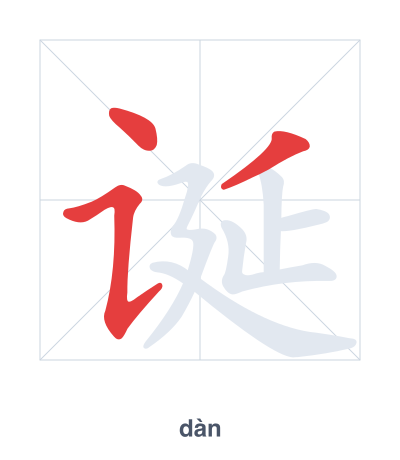
Open Hanzi Writer to see the animated stroke order and practice writing 诞 with real-time feedback.
The character 诞 (dàn) is written with 8 strokes. Follow the standard Chinese stroke order: top to bottom, left to right, outside before inside. The radical 讠 is one of its key components.
Practice the correct stroke order with the Hanzi Writer app to see animated stroke-by-stroke guidance with real-time feedback.
诞 means birth; absurd.
As an HSK Level 6 character, 诞 is an intermediate-level character.
诞 combines the speech radical 讠 with 延 (extend). It originally meant 'to speak absurdly or exaggerate', like stretching the truth. The meaning 'birth' came later, possibly from the idea of 'bringing forth' or from phrases like 诞辰 (birthday).
💡 Memory Tip: Picture a newborn baby (birth) using its speech (讠) to say absurd things while stretching (延) its tiny arms.
圣诞节快乐!
shèng dàn jié kuài lè
Merry Christmas!
一个新生命诞生了。
yí gè xīn shēng mìng dàn shēng le
A new life was born.
这个故事很荒诞。
zhè ge gù shì hěn huāng dàn
This story is very absurd.
Open Hanzi Writer to see the animated stroke order and practice writing 诞 with real-time feedback.
✨ Animated stroke order · Handwriting recognition · HSK-graded practice · Free to use
The character 诞 is composed of the speech radical 讠 on the left and the component 延 (yán) on the right. The radical hints at spoken words, while 延 means 'to extend' — together they suggest 'extending speech,' which led to meanings of announcing a birth (诞生) and exaggerated or absurd talk (荒诞).