荒 (huāng) means "Desolate; wasteland; famine" in Chinese. It has 9 strokes with the radical 艹, and is HSK Level 7.
Rated 3.7/5 in difficulty (challenging).
Harder than 31% of HSK Level 7 characters.
Appears in 3+ common words including 荒地 (huāng dì), 荒废 (huāng fèi), 荒凉 (huāng liáng).
Due to its 9 strokes, Hanzi Writer's error detection shows 荒 requires focused practice — most learners need 10+ attempts for consistent accuracy.
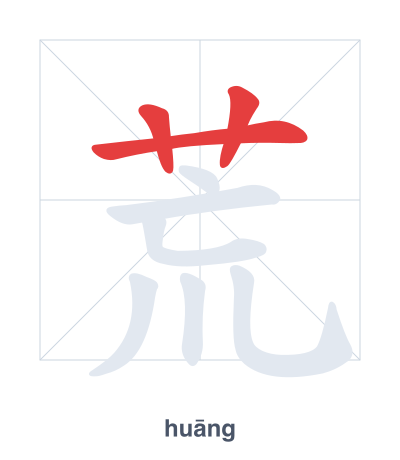
Open Hanzi Writer to see the animated stroke order and practice writing 荒 with real-time feedback.
The character 荒 (huāng) is written with 9 strokes. Follow the standard Chinese stroke order: top to bottom, left to right, outside before inside. The radical 艹 is one of its key components.
Practice the correct stroke order with the Hanzi Writer app to see animated stroke-by-stroke guidance with real-time feedback.
荒 means Desolate; wasteland; famine.
As an HSK Level 7 character, 荒 is an intermediate-level character.
荒 combines the grass radical (艹) with 巟, which originally depicted a river overflowing its banks, suggesting land flooded and then left barren—overgrown with wild grass. This imagery conveys a desolate wasteland or famine-stricken area.
💡 Memory Tip: Picture a barren wasteland where the only grass (艹) is dead, and the cracked ground resembles a dried-up riverbed (巟).
这里是一片荒地。
zhè lǐ shì yī piàn huāng dì
This is a wasteland.
别荒废了你的学业。
bié huāng fèi le nǐ de xué yè
Don't let your studies go to waste.
这个小镇很荒凉。
zhè ge xiǎo zhèn hěn huāng liáng
This small town is very desolate.
Open Hanzi Writer to see the animated stroke order and practice writing 荒 with real-time feedback.
✨ Animated stroke order · Handwriting recognition · HSK-graded practice · Free to use
荒 is made of the radical 艹 (grass) on top and 㐬 (a phonetic component) below. The grass radical connects to wild vegetation, while the overall character conveys the idea of overgrown, unkempt land, which leads to meanings like 'desolate' or 'wasteland'.