戴 (dài) means "to wear (accessories like hats, glasses, or gloves)" in Chinese. It has 17 strokes with the radical 戈, and is HSK Level 4.
Rated 4.2/5 in difficulty (advanced).
Harder than 70% of HSK Level 4 characters.
Appears in 3+ common words including 戴眼镜 (dài yǎn jìng), 戴帽子 (dài mào zi), 戴口罩 (dài kǒu zhào).
Due to its 17 strokes, Hanzi Writer's error detection shows 戴 requires focused practice — most learners need 10+ attempts for consistent accuracy.
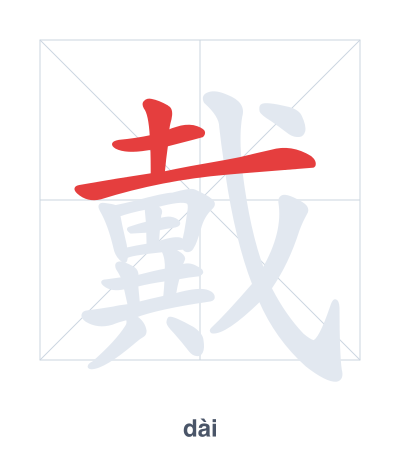
Open Hanzi Writer to see the animated stroke order and practice writing 戴 with real-time feedback.
The character 戴 (dài) is written with 17 strokes. Follow the standard Chinese stroke order: top to bottom, left to right, outside before inside. The radical 戈 is one of its key components.
Practice the correct stroke order with the Hanzi Writer app to see animated stroke-by-stroke guidance with real-time feedback.
戴 means to wear (accessories like hats, glasses, or gloves).
As an HSK Level 4 character, 戴 is an intermediate-level character.
The left component 異 originally depicted a person with a large headdress or mask, conveying the core idea of wearing something on the head. The right side 戈 (halberd) was added as a phonetic element, though its pronunciation has shifted over time. Together, the character came to mean 'to wear' accessories like hats, glasses, or gloves.
💡 Memory Tip: Picture a strange person (異) balancing a halberd (戈) on their head like a hat – that's how you 戴 (wear) accessories.
我每天戴眼镜。
wǒ měi tiān dài yǎn jìng
I wear glasses every day.
冬天要戴帽子。
dōng tiān yào dài mào zi
You should wear a hat in winter.
出门请戴口罩。
chū mén qǐng dài kǒu zhào
Please wear a mask when going out.
Open Hanzi Writer to see the animated stroke order and practice writing 戴 with real-time feedback.
✨ Animated stroke order · Handwriting recognition · HSK-graded practice · Free to use
The character 戴 is made of two parts: the left part 異 (yì) and the right radical 戈 (gē). The left part 異 originally depicted a person wearing a mask or head covering, which connects to the meaning of putting on accessories like hats or glasses. The radical 戈 is a weapon symbol that mainly gives a phonetic hint and does not directly relate to the meaning.