戍 (shù) means "to guard (a frontier)" in Chinese. It has 6 strokes with the radical 戈.
Rated 2.9/5 in difficulty (moderate).
Appears in 3+ common words including 戍边 (shù biān), 戍守 (shù shǒu), 卫戍 (wèi shù).
Hanzi Writer's stroke validation shows learners typically need 5-8 attempts to write 戍 with correct proportion and order.
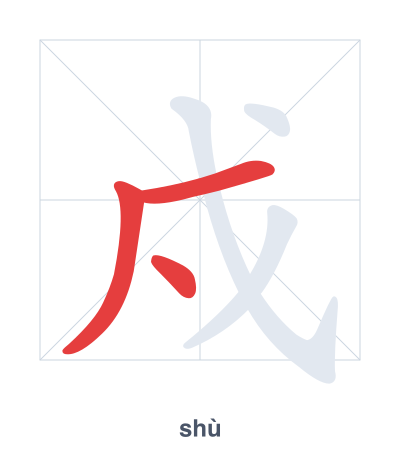
Open Hanzi Writer to see the animated stroke order and practice writing 戍 with real-time feedback.
The character 戍 (shù) is written with 6 strokes. Follow the standard Chinese stroke order: top to bottom, left to right, outside before inside. The radical 戈 is one of its key components.
Practice the correct stroke order with the Hanzi Writer app to see animated stroke-by-stroke guidance with real-time feedback.
戍 means to guard (a frontier).
This compound character combines the radical 戈 (halberd, representing a weapon) and a person 人, depicting a soldier holding a halberd while standing guard at a frontier outpost. The visual form directly shows a person with a weapon, symbolizing the act of military defense.
💡 Memory Tip: Picture a lone guard (人) gripping a halberd (戈) and standing watch at the frontier gate.
战士们在戍边。
zhàn shì men zài shù biān
The soldiers are guarding the border.
他们在戍守边疆。
tā men zài shù shǒu biān jiāng
They are guarding the border.
卫戍部队很严密。
wèi shù bù duì hěn yán mì
The garrison troops are very well-organized and strict.
Open Hanzi Writer to see the animated stroke order and practice writing 戍 with real-time feedback.
✨ Animated stroke order · Handwriting recognition · HSK-graded practice · Free to use
戍 combines the person radical 人 on the left with the weapon radical 戈 on the right. This shows a person holding a spear, which directly represents the idea of guarding or defending a frontier.