戉 (yuè) means "battle-axe" in Chinese. It has 5 strokes with the radical 戈.
Rated 2.9/5 in difficulty (moderate).
Appears in 3+ common words including 斧戉 (fǔ yuè), 戉 (yuè), 秉戉 (bǐng yuè).
Hanzi Writer's stroke validation shows learners typically need 5-8 attempts to write 戉 with correct proportion and order.
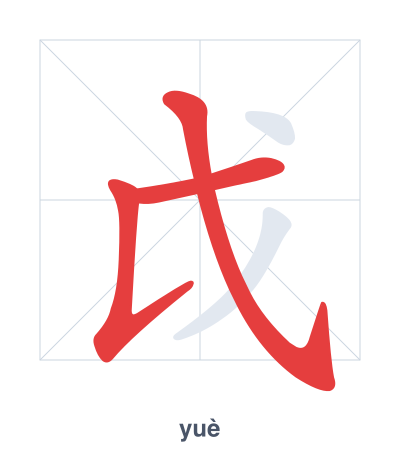
Open Hanzi Writer to see the animated stroke order and practice writing 戉 with real-time feedback.
The character 戉 (yuè) is written with 5 strokes. Follow the standard Chinese stroke order: top to bottom, left to right, outside before inside. The radical 戈 is one of its key components.
Practice the correct stroke order with the Hanzi Writer app to see animated stroke-by-stroke guidance with real-time feedback.
戉 means battle-axe.
戉 is a pictograph of a battle-axe. Ancient oracle bone script depicted a curved blade mounted on a long handle, and the modern form retains the basic shape: the left part suggests the axe blade, while the right side is a simplified handle (related to the 戈 radical meaning 'halberd').
💡 Memory Tip: Picture a crescent-moon-shaped blade (the left side) attached to a long pole (戈) — a deadly battle-axe cleaving through the air.
斧戉是古代兵器。
fǔ yuè shì gǔ dài bīng qì
The battle-axe is an ancient weapon.
戉的形状像大斧。
yuè de xíng zhuàng xiàng dà fǔ
The 'yue' is shaped like a large axe.
将军手中秉戉。
jiāng jūn shǒu zhōng bǐng yuè
The general held a battle-axe in his hand.
Open Hanzi Writer to see the animated stroke order and practice writing 戉 with real-time feedback.
✨ Animated stroke order · Handwriting recognition · HSK-graded practice · Free to use
The character 戉 is a pictograph of a battle-axe. Its radical is 戈 (spear/weapon), and the shape combines a long handle (the diagonal hook) with a broad blade (the left-falling stroke and dot). This directly represents the ancient weapon it depicts.