帽 (mào) means "Hat / Cap" in Chinese. It has 12 strokes with the radical 巾, and is HSK Level 4.
Rated 4.2/5 in difficulty (advanced).
Harder than 68% of HSK Level 4 characters.
Appears in 3+ common words including 帽子 (mào zi), 草帽 (cǎo mào), 戴帽 (dài mào).
Due to its 12 strokes, Hanzi Writer's error detection shows 帽 requires focused practice — most learners need 10+ attempts for consistent accuracy.
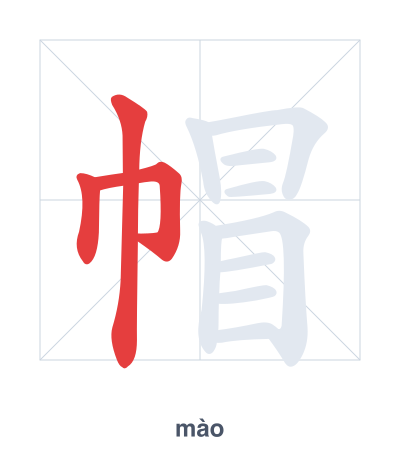
Open Hanzi Writer to see the animated stroke order and practice writing 帽 with real-time feedback.
The character 帽 (mào) is written with 12 strokes. Follow the standard Chinese stroke order: top to bottom, left to right, outside before inside. The radical 巾 is one of its key components.
Practice the correct stroke order with the Hanzi Writer app to see animated stroke-by-stroke guidance with real-time feedback.
帽 means Hat / Cap.
As an HSK Level 4 character, 帽 is an intermediate-level character.
帽 is a compound character combining the radical 巾 (cloth) with 冒 (mào), which means 'to cover.' The original form of 冒 depicted a hat covering the head, with a eye (目) beneath a covering shape (冃), so together 帽 literally means 'a cloth covering for the head.'
💡 Memory Tip: Imagine a cloth (巾) draped over the top part (冒) of your head, like a hat covering a startled eye (目) beneath—that's your cap!
这顶帽子很漂亮。
zhè dǐng mào zi hěn piào liàng
This hat is very beautiful.
爷爷戴着草帽。
yé yé dài zhe cǎo mào
Grandpa is wearing a straw hat.
出门记得戴帽。
chū mén jì de dài mào
Remember to wear a hat when going out.
Open Hanzi Writer to see the animated stroke order and practice writing 帽 with real-time feedback.
✨ Animated stroke order · Handwriting recognition · HSK-graded practice · Free to use
The left part is 巾, the cloth radical, which shows that hats are made from fabric. The right part is 冒, which gives the sound and also suggests covering, as a hat covers the head.