戈 (gē) means "dagger-axe; halberd" in Chinese. It has 4 strokes with the radical 戈, and is HSK Level 7.
Rated 2.4/5 in difficulty (moderate).
Harder than 2% of HSK Level 7 characters.
Appears in 3+ common words including 戈壁 (gē bì), 干戈 (gān gē), 戈 (gē).
Hanzi Writer's stroke validation shows learners typically need 5-8 attempts to write 戈 with correct proportion and order.
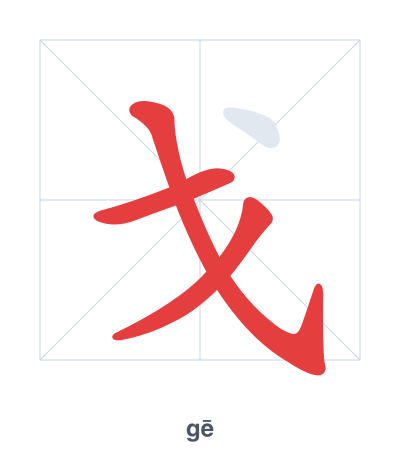
Open Hanzi Writer to see the animated stroke order and practice writing 戈 with real-time feedback.
The character 戈 (gē) is written with 4 strokes. Follow the standard Chinese stroke order: top to bottom, left to right, outside before inside. The radical 戈 is one of its key components.
Practice the correct stroke order with the Hanzi Writer app to see animated stroke-by-stroke guidance with real-time feedback.
戈 means dagger-axe; halberd.
As an HSK Level 7 character, 戈 is an intermediate-level character.
戈 is a pictograph of a dagger-axe, an ancient Chinese weapon used in chariot warfare. The character's form clearly shows a long handle with a horizontal blade at the top, resembling a halberd.
💡 Memory Tip: Picture the character 戈 as a warrior's halberd slicing through the air, with the horizontal stroke as the blade and the hook as the blade's bottom curve.
戈壁滩非常大。
gē bì tān fēi cháng dà
The Gobi Desert is very large.
我们不要动干戈。
wǒ men bú yào dòng gān gē
We should not resort to violence.
戈是古代的兵器。
gē shì gǔ dài de bīng qì
The 'ge' is an ancient weapon.
Open Hanzi Writer to see the animated stroke order and practice writing 戈 with real-time feedback.
✨ Animated stroke order · Handwriting recognition · HSK-graded practice · Free to use
戈 is a simple pictograph that directly depicts a dagger-axe, an ancient Chinese weapon with a blade and a long handle. It has no separate components; the entire shape represents the weapon itself. This makes 戈 both a character and a radical, often used in symbols of warfare or conflict.