威 (wēi) means "power; might; prestige" in Chinese. It has 9 strokes with the radical 戈, and is HSK Level 6.
Rated 4/5 in difficulty (challenging).
Harder than 45% of HSK Level 6 characters.
Appears in 3+ common words including 威风 (wēi fēng), 威力 (wēi lì), 威信 (wēi xìn).
Due to its 9 strokes, Hanzi Writer's error detection shows 威 requires focused practice — most learners need 10+ attempts for consistent accuracy.
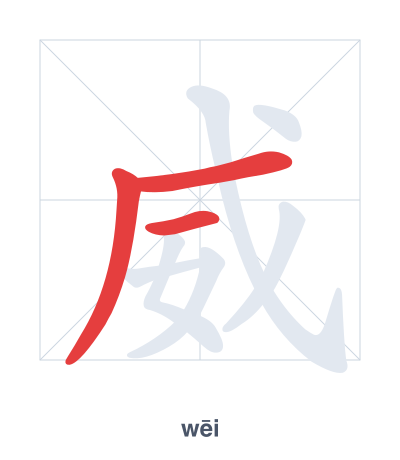
Open Hanzi Writer to see the animated stroke order and practice writing 威 with real-time feedback.
The character 威 (wēi) is written with 9 strokes. Follow the standard Chinese stroke order: top to bottom, left to right, outside before inside. The radical 戈 is one of its key components.
Practice the correct stroke order with the Hanzi Writer app to see animated stroke-by-stroke guidance with real-time feedback.
威 means power; might; prestige.
As an HSK Level 6 character, 威 is an intermediate-level character.
威 combines a halberd (戊) over a woman (女), originally depicting the awe-inspiring power of a weapon dominating a person. This visual conveys authority and might, as the halberd represents coercive force.
💡 Memory Tip: Picture a woman (女) shrinking beneath a huge halberd (戊) — that's raw power that commands respect.
他穿上制服很威风。
tā chuān shàng zhì fú hěn wēi fēng
He looks very impressive in his uniform.
这种药的威力很大。
zhè zhǒng yào de wēi lì hěn dà
This medicine is very powerful.
老师在班里很有威信。
lǎo shī zài bān lǐ hěn yǒu wēi xìn
The teacher has great prestige in the class.
Open Hanzi Writer to see the animated stroke order and practice writing 威 with real-time feedback.
✨ Animated stroke order · Handwriting recognition · HSK-graded practice · Free to use
威 combines the component 戈 (a spear or weapon) above the component 女 (woman). This suggests the image of a weapon being held over a woman, representing power, might, and dominance. The structure visually shows strength exerted over another, linking directly to the meaning of prestige and authority.