戊 (wù) means "the fifth of the ten Heavenly Stems" in Chinese. It has 5 strokes with the radical 戈.
Rated 2.9/5 in difficulty (moderate).
Appears in 3+ common words including 戊戌 (wù xū), 戊 (wù), 戊子 (wù zi).
Hanzi Writer's stroke validation shows learners typically need 5-8 attempts to write 戊 with correct proportion and order.
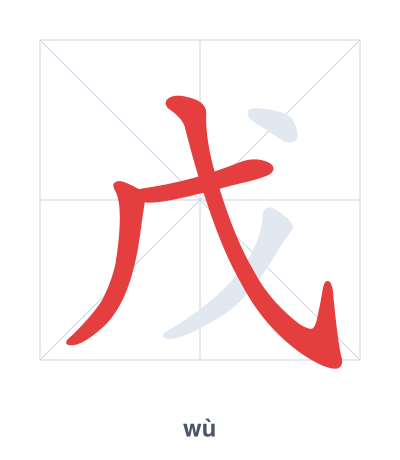
Open Hanzi Writer to see the animated stroke order and practice writing 戊 with real-time feedback.
The character 戊 (wù) is written with 5 strokes. Follow the standard Chinese stroke order: top to bottom, left to right, outside before inside. The radical 戈 is one of its key components.
Practice the correct stroke order with the Hanzi Writer app to see animated stroke-by-stroke guidance with real-time feedback.
戊 means the fifth of the ten Heavenly Stems.
戊 was originally a pictograph of a long-handled axe or halberd, a type of ancient weapon. Its form evolved from a curved blade on a staff, and it was later borrowed to represent the fifth Heavenly Stem in the Chinese cyclical calendar.
💡 Memory Tip: Imagine a curved axe blade (the shape of 戊) chopping down a tree, and since it's the fifth swing, you count 'wu'—the fifth Heavenly Stem.
戊戌变法很有名。
wù xū biàn fǎ hěn yǒu míng
The Hundred Days' Reform is very famous.
戊在天干中排第五。
wù zài tiān gān zhōng pái dì wǔ
'Wu' is the fifth of the Heavenly Stems.
今年是戊子年。
jīn nián shì wù zi nián
This year is the Wuzi year (Year of the Earth Rat).
Open Hanzi Writer to see the animated stroke order and practice writing 戊 with real-time feedback.
✨ Animated stroke order · Handwriting recognition · HSK-graded practice · Free to use
戊 is built with the radical 戈 (halberd, a weapon) and a horizontal stroke on top. However, its meaning as the fifth Heavenly Stem is not directly connected to these visual components — the character is an ancient symbol used as an ordinal marker in the Chinese calendar and cosmology.