罩 (zhào) means "To cover; a mask; a hood" in Chinese. It has 13 strokes with the radical 罒, and is HSK Level 7.
Rated 4.2/5 in difficulty (advanced).
Harder than 81% of HSK Level 7 characters.
Appears in 3+ common words including 口罩 (kǒu zhào), 灯罩 (dēng zhào), 罩衫 (zhào shān).
Due to its 13 strokes, Hanzi Writer's error detection shows 罩 requires focused practice — most learners need 10+ attempts for consistent accuracy.
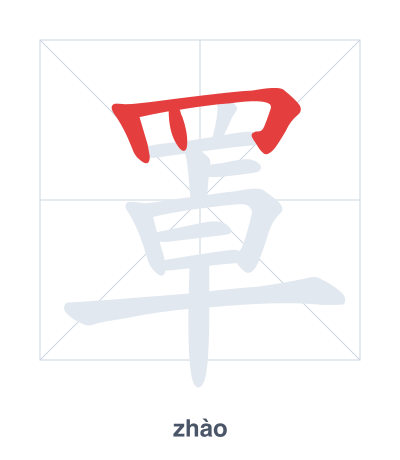
Open Hanzi Writer to see the animated stroke order and practice writing 罩 with real-time feedback.
The character 罩 (zhào) is written with 13 strokes. Follow the standard Chinese stroke order: top to bottom, left to right, outside before inside. The radical 罒 is one of its key components.
Practice the correct stroke order with the Hanzi Writer app to see animated stroke-by-stroke guidance with real-time feedback.
罩 means To cover; a mask; a hood.
As an HSK Level 7 character, 罩 is an intermediate-level character.
罩 is a phono-semantic compound: the radical 罒 (a net) represents covering or enclosing, while 卓 (zhuó, meaning tall or upright) provides the sound (pronounced zhào). Together, the image is of a net or hood placed over something to conceal or protect it.
💡 Memory Tip: Picture a net (罒) dropping over a tall figure (卓) like a giant hood—'zhao'! Now they're covered.
请戴好口罩。
qǐng dài hǎo kǒu zhào
Please wear your mask properly.
这个灯罩很漂亮。
zhè ge dēng zhào hěn piào liàng
This lampshade is very beautiful.
她穿着一件罩衫。
tā chuān zhe yī jiàn zhào shān
She is wearing a blouse.
Open Hanzi Writer to see the animated stroke order and practice writing 罩 with real-time feedback.
✨ Animated stroke order · Handwriting recognition · HSK-graded practice · Free to use
罩 has the radical 罒 on top and 卓 (zhuō) below. The top radical 罒 originally meant a net or cover, and 卓 adds a sense of high or prominent, together suggesting something that covers from above like a hood or mask.