窗 (chuāng) means "A window." in Chinese. It has 12 strokes with the radical 穴, and is HSK Level 4.
Rated 4.2/5 in difficulty (advanced).
Harder than 83% of HSK Level 4 characters.
Appears in 3+ common words including 窗户 (chuāng hù), 窗口 (chuāng kǒu), 窗帘 (chuāng lián).
Due to its 12 strokes, Hanzi Writer's error detection shows 窗 requires focused practice — most learners need 10+ attempts for consistent accuracy.
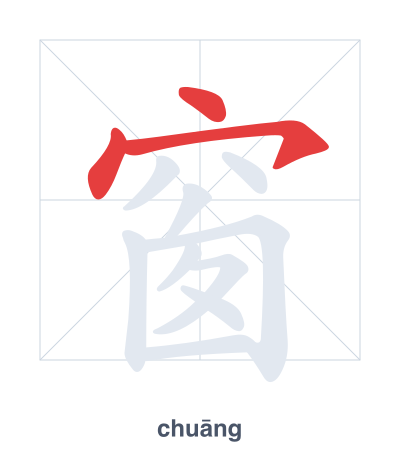
Open Hanzi Writer to see the animated stroke order and practice writing 窗 with real-time feedback.
The character 窗 (chuāng) is written with 12 strokes. Follow the standard Chinese stroke order: top to bottom, left to right, outside before inside. The radical 穴 is one of its key components.
Practice the correct stroke order with the Hanzi Writer app to see animated stroke-by-stroke guidance with real-time feedback.
窗 means A window..
As an HSK Level 4 character, 窗 is an intermediate-level character.
窗 combines the radical 穴 (cave/hole) with 囱, which originally depicted a window or chimney in ancient scripts. The 穴 indicates an opening in a wall, while 囱 provides the sound and reinforces the meaning of a vent or window. Together, 窗 signifies a window—a hole in a structure for light and air.
💡 Memory Tip: Imagine a cave (穴) with a square window (囱) letting in the evening moonlight (夕).
请打开窗户。
qǐng dǎ kāi chuāng hù
Please open the window.
在窗口买票。
zài chuāng kǒu mǎi piào
Buy tickets at the window.
拉上窗帘吧。
lā shàng chuāng lián ba
Draw the curtains.
Open Hanzi Writer to see the animated stroke order and practice writing 窗 with real-time feedback.
✨ Animated stroke order · Handwriting recognition · HSK-graded practice · Free to use
The top part is the radical 穴, meaning a cave or hole, and the bottom part is 囱, which originally meant a window or skylight. Together, the character represents a hole in a wall that lets in light and air, which is the idea of a window.