窀 (zhūn) means "Burial or grave (archaic)." in Chinese. It has 9 strokes with the radical 穴.
Rated 4/5 in difficulty (challenging).
Appears in 3+ common words including 窀穸 (zhūn xī), 窀夕 (zhūn xī), 窀穸之事 (zhūn xī zhī shì).
Due to its 9 strokes, Hanzi Writer's error detection shows 窀 requires focused practice — most learners need 10+ attempts for consistent accuracy.
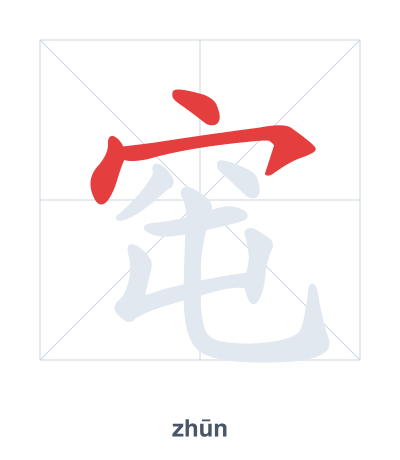
Open Hanzi Writer to see the animated stroke order and practice writing 窀 with real-time feedback.
The character 窀 (zhūn) is written with 9 strokes. Follow the standard Chinese stroke order: top to bottom, left to right, outside before inside. The radical 穴 is one of its key components.
Practice the correct stroke order with the Hanzi Writer app to see animated stroke-by-stroke guidance with real-time feedback.
窀 means Burial or grave (archaic)..
This character is a phono-semantic compound combining 穴 (cave, tomb pit) with 屯 (phonetic, originally a sprouting plant but here indicating the sound zhūn). Together, 穴 suggests the underground burial chamber, and 屯 contributes the pronunciation, creating the archaic meaning of a grave or burial place.
💡 Memory Tip: Imagine a cave (穴) with a curled-up body (屯 looks like a fetal position) buried deep inside as a grave.
这是窀穸。
zhè shì zhūn xī
This is a tomb.
窀夕已经安排好了。
zhūn xī yǐ jīng ān pái hǎo le
The burial arrangements have been made.
他在处理窀穸之事。
tā zài chǔ lǐ zhūn xī zhī shì
He is handling burial matters.
Open Hanzi Writer to see the animated stroke order and practice writing 窀 with real-time feedback.
✨ Animated stroke order · Handwriting recognition · HSK-graded practice · Free to use
窀 is composed of the radical 穴 (cave) on top and the component 屯 (tún) below. The radical 穴 suggests a hole or underground space, while 屯 can mean 'to store' or 'to accumulate.' Together they imply a place where something is stored underground, which fits the archaic meaning of a grave or tomb.