穸 (xī) means "Tomb / dark" in Chinese. It has 8 strokes with the radical 穴.
Rated 3.7/5 in difficulty (challenging).
Appears in 3+ common words including 窀穸 (zhūn xī), 穸台 (xī tái), 穸穴 (xī xué).
Due to its 8 strokes, Hanzi Writer's error detection shows 穸 requires focused practice — most learners need 10+ attempts for consistent accuracy.
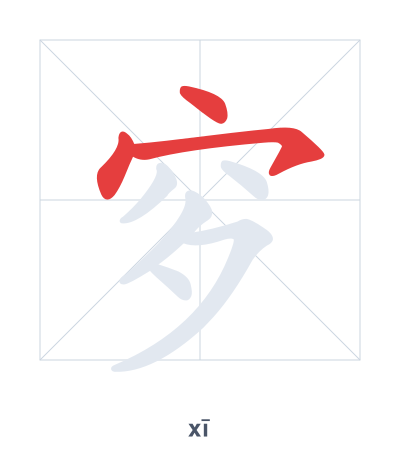
Open Hanzi Writer to see the animated stroke order and practice writing 穸 with real-time feedback.
The character 穸 (xī) is written with 8 strokes. Follow the standard Chinese stroke order: top to bottom, left to right, outside before inside. The radical 穴 is one of its key components.
Practice the correct stroke order with the Hanzi Writer app to see animated stroke-by-stroke guidance with real-time feedback.
穸 means Tomb / dark.
穸 is a compound character formed by the radical 穴 (cave) and the component 夕 (evening/dusk). The cave represents a tomb, while 夕 adds the sense of darkness, together conveying a dark burial place.
💡 Memory Tip: Imagine a dark cave (穴) at dusk (夕) where a tomb lies hidden inside.
这是一个窀穸。
zhè shì yí gè zhūn xī
This is a tomb.
他在看穸台。
tā zài kàn xī tái
He is looking at the tomb site.
穸穴在山下。
xī xué zài shān xià
The grave is at the foot of the mountain.
Open Hanzi Writer to see the animated stroke order and practice writing 穸 with real-time feedback.
✨ Animated stroke order · Handwriting recognition · HSK-graded practice · Free to use
The character 穸 combines the radical 穴 (cave or hole) on top with 夕 (evening or dusk) below. The cave radical suggests an underground space, and 夕 adds the idea of darkness, together meaning "tomb" or "dark." This structure visually shows a dark, cave-like burial place.