穵 (wā) means "To dig" in Chinese. It has 6 strokes with the radical 穴.
Rated 3.2/5 in difficulty (challenging).
Appears in 3+ common words including 穵洞 (wā dòng), 穵土 (wā tǔ), 穵坑 (wā kēng).
Due to its 6 strokes, Hanzi Writer's error detection shows 穵 requires focused practice — most learners need 10+ attempts for consistent accuracy.
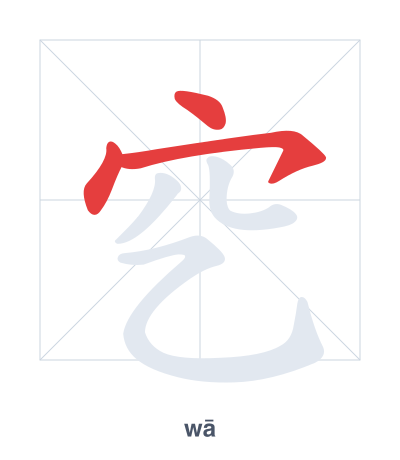
Open Hanzi Writer to see the animated stroke order and practice writing 穵 with real-time feedback.
The character 穵 (wā) is written with 6 strokes. Follow the standard Chinese stroke order: top to bottom, left to right, outside before inside. The radical 穴 is one of its key components.
Practice the correct stroke order with the Hanzi Writer app to see animated stroke-by-stroke guidance with real-time feedback.
穵 means To dig.
穵 combines the radical 穴 (cave/hole) with 乙, which originally depicted a curved digging tool or a hand reaching into the earth, together showing the action of hollowing out or digging a hole.
💡 Memory Tip: Imagine a cave (穴) entrance with a bent shovel (乙) sticking out, as if someone is digging deep inside.
兔子在穵洞。
tù zi zài wā dòng
The rabbit is digging a hole.
他在用力穵土。
tā zài yòng lì wā tǔ
He is digging the soil with force.
我们在地上穵坑。
wǒ men zài dì shàng wā kēng
We are digging a hole in the ground.
Open Hanzi Writer to see the animated stroke order and practice writing 穵 with real-time feedback.
✨ Animated stroke order · Handwriting recognition · HSK-graded practice · Free to use
穵 combines the radical 穴 (cave) on top with a curving stroke below, suggesting the action of hollowing out a cave or hole. The 穴 radical indicates a cavity or opening, and the lower part mimics the shape of a hand or tool digging. This structure directly conveys the meaning "to dig."