突 (tū) means "Sudden, abrupt, or to dash." in Chinese. It has 9 strokes with the radical 穴, and is HSK Level 3.
Rated 4/5 in difficulty (challenging).
Harder than 67% of HSK Level 3 characters.
Appears in 3+ common words including 突然 (tū rán), 突破 (tū pò), 突出 (tū chū).
Due to its 9 strokes, Hanzi Writer's error detection shows 突 requires focused practice — most learners need 10+ attempts for consistent accuracy.
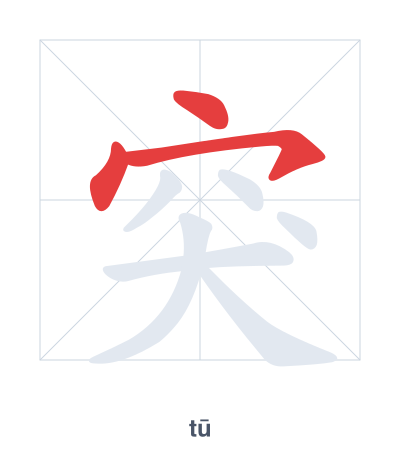
Open Hanzi Writer to see the animated stroke order and practice writing 突 with real-time feedback.
The character 突 (tū) is written with 9 strokes. Follow the standard Chinese stroke order: top to bottom, left to right, outside before inside. The radical 穴 is one of its key components.
Practice the correct stroke order with the Hanzi Writer app to see animated stroke-by-stroke guidance with real-time feedback.
突 means Sudden, abrupt, or to dash..
As an HSK Level 3 character, 突 is an intermediate-level character.
突 combines a cave (穴) and a dog (犬), depicting a dog suddenly dashing out of a cave, reflecting the meaning of 'sudden' or 'abrupt' action.
💡 Memory Tip: A dog (犬) bursts out of a cave (穴) with a sudden dash, catching everyone off guard.
他突然走了。
tā tū rán zǒu le
He suddenly left.
我们突破了难关。
wǒ men tū pò le nán guān
We overcame the difficulties.
他的表现很突出。
tā de biǎo xiàn hěn tū chū
His performance is outstanding.
Open Hanzi Writer to see the animated stroke order and practice writing 突 with real-time feedback.
✨ Animated stroke order · Handwriting recognition · HSK-graded practice · Free to use
突 is made of the radical 穴 (cave) on top and 犬 (dog) below. The image of a dog suddenly dashing out of a cave gives the meanings "sudden" and "to dash." This combination directly shows a sudden movement from a hidden place.