穹 (qióng) means "Vault / dome / sky" in Chinese. It has 8 strokes with the radical 穴.
Rated 3.7/5 in difficulty (challenging).
Appears in 3+ common words including 穹顶 (qióng dǐng), 苍穹 (cāng qióng), 穹隆 (qióng lóng).
Due to its 8 strokes, Hanzi Writer's error detection shows 穹 requires focused practice — most learners need 10+ attempts for consistent accuracy.
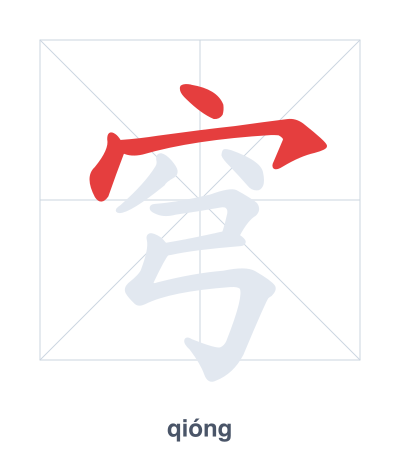
Open Hanzi Writer to see the animated stroke order and practice writing 穹 with real-time feedback.
The character 穹 (qióng) is written with 8 strokes. Follow the standard Chinese stroke order: top to bottom, left to right, outside before inside. The radical 穴 is one of its key components.
Practice the correct stroke order with the Hanzi Writer app to see animated stroke-by-stroke guidance with real-time feedback.
穹 means Vault / dome / sky.
The character 穹 combines the radical 穴 (cave or hole) above 弓 (bow), suggesting an arched shape like a bow over a cavity. This depicts a vaulted ceiling or dome, like the sky arching over the earth like an immense bow over a cave.
💡 Memory Tip: Picture a giant bow (弓) stretched tensely over a cave entrance (穴), forming a curved dome like the sky above.
这里的穹顶很漂亮。
zhè lǐ de qióng dǐng hěn piào liàng
The dome here is very beautiful.
苍穹是蓝色的。
cāng qióng shì lán sè de
The firmament is blue.
这是一个穹隆建筑。
zhè shì yí gè qióng lóng jiàn zhù
This is a vaulted building.
Open Hanzi Writer to see the animated stroke order and practice writing 穹 with real-time feedback.
✨ Animated stroke order · Handwriting recognition · HSK-graded practice · Free to use
穹 combines the radical 穴 (cave) on top with 弓 (bow) below. The cave radical suggests a hollow or arched space, while 弓 resembles a curved bow, together evoking the image of a curved, vaulted ceiling like a dome or the sky.