窄 (zhǎi) means "Narrow." in Chinese. It has 10 strokes with the radical 穴, and is HSK Level 7.
Rated 4.2/5 in difficulty (advanced).
Harder than 77% of HSK Level 7 characters.
Appears in 3+ common words including 很窄 (hěn zhǎi), 狭窄 (xiá zhǎi), 窄小 (zhǎi xiǎo).
Due to its 10 strokes, Hanzi Writer's error detection shows 窄 requires focused practice — most learners need 10+ attempts for consistent accuracy.
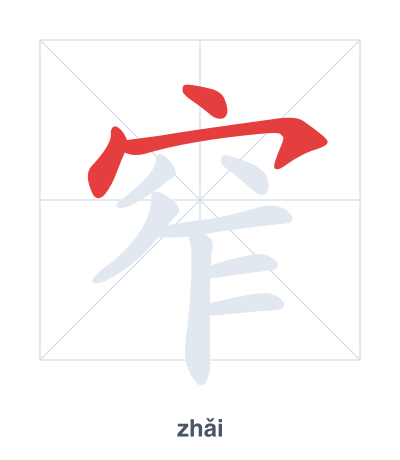
Open Hanzi Writer to see the animated stroke order and practice writing 窄 with real-time feedback.
The character 窄 (zhǎi) is written with 10 strokes. Follow the standard Chinese stroke order: top to bottom, left to right, outside before inside. The radical 穴 is one of its key components.
Practice the correct stroke order with the Hanzi Writer app to see animated stroke-by-stroke guidance with real-time feedback.
窄 means Narrow..
As an HSK Level 7 character, 窄 is an intermediate-level character.
窄 combines the radical 穴 (cave, implying a confined space) with the phonetic component 乍 (zhà, which also hints at 'sudden' or 'narrowing'). The character visually represents a cave so tight that one can barely pass through, thus meaning narrow.
💡 Memory Tip: Picture a cave (穴) so narrow you must suddenly (乍) turn sideways to squeeze through.
这条路很窄。
zhè tiáo lù hěn zhǎi
This road is very narrow.
这里的空间很狭窄。
zhè lǐ de kōng jiān hěn xiá zhǎi
The space here is very narrow.
这个房间很窄小。
zhè ge fáng jiān hěn zhǎi xiǎo
This room is very narrow and small.
Open Hanzi Writer to see the animated stroke order and practice writing 窄 with real-time feedback.
✨ Animated stroke order · Handwriting recognition · HSK-graded practice · Free to use
The character 窄 is composed of the radical 穴 (cave) on top and the component 乍 (zhà, meaning sudden) below. Together they suggest a cave that suddenly becomes narrow or tight, forming the meaning "narrow."