穴 (xué) means "Hole; cave; acupuncture point" in Chinese. It has 5 strokes with the radical 穴, and is HSK Level 7.
Rated 2.7/5 in difficulty (moderate).
Harder than 4% of HSK Level 7 characters.
Appears in 3+ common words including 洞穴 (dòng xué), 穴位 (xué wèi), 巢穴 (cháo xué).
Hanzi Writer's stroke validation shows learners typically need 5-8 attempts to write 穴 with correct proportion and order.
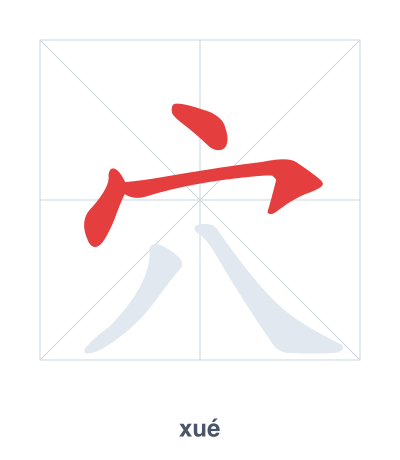
Open Hanzi Writer to see the animated stroke order and practice writing 穴 with real-time feedback.
The character 穴 (xué) is written with 5 strokes. Follow the standard Chinese stroke order: top to bottom, left to right, outside before inside. The radical 穴 is one of its key components.
Practice the correct stroke order with the Hanzi Writer app to see animated stroke-by-stroke guidance with real-time feedback.
穴 means Hole; cave; acupuncture point.
As an HSK Level 7 character, 穴 is an intermediate-level character.
The character 穴 is a pictograph of a cave or a hole in the ground. Its ancient form depicted a shelter carved into a rock face, with the top part representing the overhanging roof and the lower part showing the opening. The modern shape preserves this idea: a cover (丶) over a hole (八).
💡 Memory Tip: Imagine the top stroke as a rocky overhang and the '八' below as two narrow paths leading into a dark cave.
山里有一个洞穴。
shān lǐ yǒu yí gè dòng xué
There is a cave in the mountains.
中医讲究穴位。
zhōng yī jiǎng jiū xué wèi
TCM emphasizes acupuncture points.
鸟儿回到了巢穴。
niǎo ér huí dào le cháo xué
The bird returned to its nest.
Open Hanzi Writer to see the animated stroke order and practice writing 穴 with real-time feedback.
✨ Animated stroke order · Handwriting recognition · HSK-graded practice · Free to use
穴 is a pictograph of a cave or hole. The top part (宀-like) represents a roof or covering, and the bottom part (八) represents the opening or split, together meaning a cavity.