Hanzi Writer

How to Write 穷 (qióng) — Meaning “Poor / exhausted”

qióng HSK Level 4 7 strokes Radical: 穴

穷 (qióng) means "Poor / exhausted" in Chinese. It has 7 strokes with the radical 穴, and is HSK Level 4.

Rated 3.5/5 in difficulty (challenging).

Harder than 35% of HSK Level 4 characters.

Appears in 3+ common words including 贫穷 (pín qióng), 穷人 (qióng rén), 无穷 (wú qióng).

Due to its 7 strokes, Hanzi Writer's error detection shows 穷 requires focused practice — most learners need 10+ attempts for consistent accuracy.
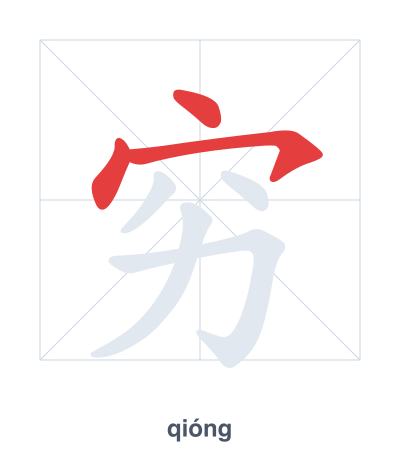
Stroke order practice for 穷 - qióng

Practice Writing 穷 (qióng)

Open Hanzi Writer to see the animated stroke order and practice writing 穷 with real-time feedback.

The character (qióng) is written with 7 strokes. Follow the standard Chinese stroke order: top to bottom, left to right, outside before inside. The radical is one of its key components.

Practice the correct stroke order with the Hanzi Writer app to see animated stroke-by-stroke guidance with real-time feedback.

means Poor / exhausted.

As an HSK Level 4 character, is an intermediate-level character.

Character
Pinyinqióng (qiong)
MeaningPoor / exhausted
Strokes7
Radical
HSK Level4
Difficulty3.5/5

Combines the radical 穴 (cave) with 躬 (bent body). The ancient form depicted a person stooped inside a cave, symbolizing exhaustion or the end of resources, which later came to mean 'poor' and 'exhausted'.

💡 Memory Tip: Picture a person hunched over (躬) in a dark cave (穴), too poor to afford a house.

pín qióng
Poor / Poverty
qióng rén
Poor people
wú qióng
Infinite / endless

这个地方很贫穷。

zhè ge dì fāng hěn pín qióng

This place is very poor.

他是一个穷人。

tā shì yí gè qióng rén

He is a poor person.

这里的乐趣无穷。

zhè lǐ de lè qù wú qióng

There is endless fun here.

Character Pinyin Strokes Radical
(current) qióng 7
xué 5
6
jiū 7
Stroke order practice for 穷 - qióng

Practice Writing 穷 (qióng)

Open Hanzi Writer to see the animated stroke order and practice writing 穷 with real-time feedback.

✨ Animated stroke order · Handwriting recognition · HSK-graded practice · Free to use

Frequently Asked Questions about 穷

穷 combines the radical 穴 (cave) on top and 力 (strength) below, suggesting a person exerting strength in a cave — a place of hardship or poverty. The radical 穴 gives the idea of being confined or limited, while 力 shows effort, together conveying the sense of being poor or exhausted.

More HSK Level 4 Characters

Characters with Radical 穴

Other 7-Stroke Characters