除 (chú) means "To remove; to divide; except." in Chinese. It has 9 strokes with the radical 阝, and is HSK Level 3.
Rated 3.7/5 in difficulty (challenging).
Harder than 56% of HSK Level 3 characters.
Appears in 3+ common words including 除了 (chú le), 消除 (xiāo chú), 除法 (chú fǎ).
Due to its 9 strokes, Hanzi Writer's error detection shows 除 requires focused practice — most learners need 10+ attempts for consistent accuracy.
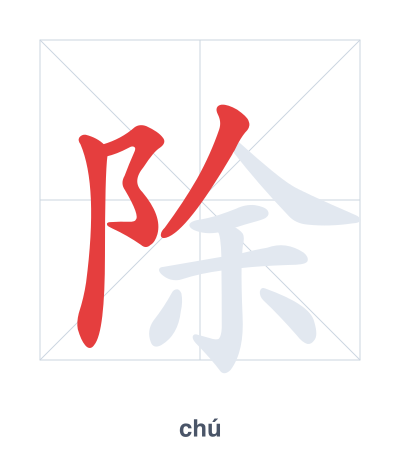
Open Hanzi Writer to see the animated stroke order and practice writing 除 with real-time feedback.
The character 除 (chú) is written with 9 strokes. Follow the standard Chinese stroke order: top to bottom, left to right, outside before inside. The radical 阝 is one of its key components.
Practice the correct stroke order with the Hanzi Writer app to see animated stroke-by-stroke guidance with real-time feedback.
除 means To remove; to divide; except..
As an HSK Level 3 character, 除 is an intermediate-level character.
除 is a phono-semantic compound, where the left radical 阝 (originally a picture of steps or a mound) suggests a path or elevation, and the right part 余 (surplus) provides the sound. Its ancient meaning was to remove obstacles or clear away, like sweeping steps clean of excess earth.
💡 Memory Tip: Picture a surplus (余) of trash on a staircase (阝), and you must remove (除) it all to clear the way.
除了他,大家都来了。
chú le tā dà jiā dōu lái le
Everyone came except him.
消除工作的压力。
xiāo chú gōng zuò de yā lì
To relieve work stress.
老师在教除法。
lǎo shī zài jiào chú fǎ
The teacher is teaching division.
Open Hanzi Writer to see the animated stroke order and practice writing 除 with real-time feedback.
✨ Animated stroke order · Handwriting recognition · HSK-graded practice · Free to use
The character 除 has the left radical 阝 (meaning hill or mound) and the right component 余 (meaning surplus or remainder). The combination suggests removing a surplus from a pile, which connects to its meanings of 'to remove', 'to divide', and 'except'.