邰 (tái) means "Tai (a surname)" in Chinese. It has 7 strokes with the radical 阝.
Rated 3.2/5 in difficulty (challenging).
Appears in 3+ common words including 邰先生 (tái xiān shēng), 姓邰 (xìng tái), 邰家 (tái jiā).
Due to its 7 strokes, Hanzi Writer's error detection shows 邰 requires focused practice — most learners need 10+ attempts for consistent accuracy.
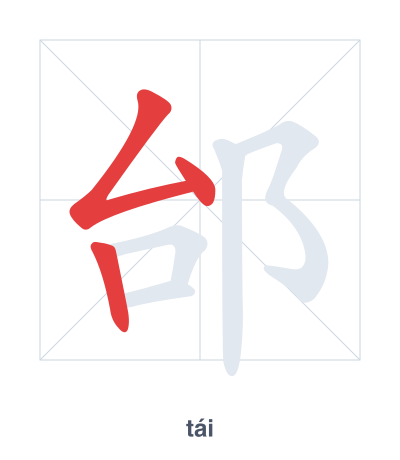
Open Hanzi Writer to see the animated stroke order and practice writing 邰 with real-time feedback.
The character 邰 (tái) is written with 7 strokes. Follow the standard Chinese stroke order: top to bottom, left to right, outside before inside. The radical 阝 is one of its key components.
Practice the correct stroke order with the Hanzi Writer app to see animated stroke-by-stroke guidance with real-time feedback.
邰 means Tai (a surname).
邰 combines the radical 阝 (a variant of 邑, meaning 'town' or 'city') on the left with 台 (tái, meaning 'terrace' or 'platform') on the right as a phonetic component. It originally referred to an ancient state or place name in the Zhou dynasty, and later became a surname for descendants of that region.
💡 Memory Tip: Picture a terrace (台) at the edge of a walled city (阝), where the Tai family holds their ancestral meetings.
邰先生今天没来。
tái xiān shēng jīn tiān méi lái
Mr. Tai didn't come today.
很少有人姓邰。
hěn shǎo yǒu rén xìng tái
Few people have the surname Tai.
邰家的人都很好。
tái jiā de rén dōu hěn hǎo
The people in the Tai family are all very nice.
Open Hanzi Writer to see the animated stroke order and practice writing 邰 with real-time feedback.
✨ Animated stroke order · Handwriting recognition · HSK-graded practice · Free to use
邰 is made of the radical 阝 on the left, which represents a city or mound, and 台 on the right, which means platform. Originally 邰 referred to a place name, so the radical suggests a location, but today it is only used as a surname without a direct literal meaning.