邯 (hán) means "Han (used in place names)" in Chinese. It has 7 strokes with the radical 阝.
Rated 3.2/5 in difficulty (challenging).
Appears in 3+ common words including 邯郸 (hán dān), 邯郸路 (hán dān lù), 邯郸学步 (hán dān xué bù).
Due to its 7 strokes, Hanzi Writer's error detection shows 邯 requires focused practice — most learners need 10+ attempts for consistent accuracy.
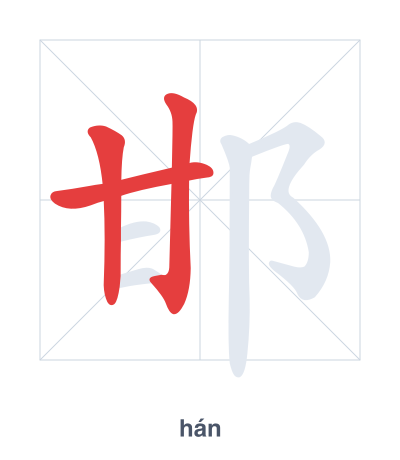
Open Hanzi Writer to see the animated stroke order and practice writing 邯 with real-time feedback.
The character 邯 (hán) is written with 7 strokes. Follow the standard Chinese stroke order: top to bottom, left to right, outside before inside. The radical 阝 is one of its key components.
Practice the correct stroke order with the Hanzi Writer app to see animated stroke-by-stroke guidance with real-time feedback.
邯 means Han (used in place names).
邯 is a phonetic-semantic compound. The left radical 阝 (representing a mound or hill) indicates a place, while the right component 甘 (originally meaning 'sweet') contributes the sound hán. This character is most famous in the place name 邯郸 (Handan), an ancient city in Hebei province.
💡 Memory Tip: Picture a hill (阝) made of sweet (甘) soil, marking the ancient city of Handan.
邯郸是个古城。
hán dān shì gè gǔ chéng
Handan is an ancient city.
我住在邯郸路。
wǒ zhù zài hán dān lù
I live on Handan Road.
学习不能邯郸学步。
xué xí bù néng hán dān xué bù
One should not lose their own way by blindly imitating others.
Open Hanzi Writer to see the animated stroke order and practice writing 邯 with real-time feedback.
✨ Animated stroke order · Handwriting recognition · HSK-graded practice · Free to use
邯 consists of the left radical 阝 (meaning 'city' or 'place') and the right component 甘 (meaning 'sweet'). The radical indicates that this character is a place name, and together they form the name of the ancient city Handan.