补 (bǔ) means "To mend / To supplement" in Chinese. It has 7 strokes with the radical 衤, and is HSK Level 3.
Rated 3.5/5 in difficulty (challenging).
Harder than 44% of HSK Level 3 characters.
Appears in 3+ common words including 补课 (bǔ kè), 补充 (bǔ chōng), 修补 (xiū bǔ).
Due to its 7 strokes, Hanzi Writer's error detection shows 补 requires focused practice — most learners need 10+ attempts for consistent accuracy.
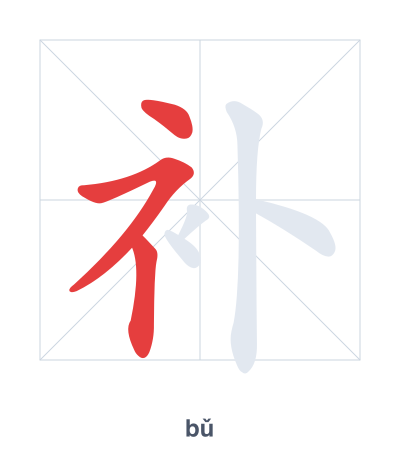
Open Hanzi Writer to see the animated stroke order and practice writing 补 with real-time feedback.
The character 补 (bǔ) is written with 7 strokes. Follow the standard Chinese stroke order: top to bottom, left to right, outside before inside. The radical 衤 is one of its key components.
Practice the correct stroke order with the Hanzi Writer app to see animated stroke-by-stroke guidance with real-time feedback.
补 means To mend / To supplement.
As an HSK Level 3 character, 补 is an intermediate-level character.
补 originally depicted a person mending clothes, combining the clothing radical 衤 with 卜, which originally meant 'to divine' but here acts as a phonetic component suggesting the sound 'bu'. Over time, the meaning expanded from mending clothes to any kind of supplement or repair.
💡 Memory Tip: Imagine a shirt with a hole, and you patch it with a piece of cloth shaped like a fortune-telling stick (卜) — that's 补: patching up what's missing.
老师今天给我补课。
lǎo shī jīn tiān gěi wǒ bǔ kè
The teacher is giving me a make-up lesson today.
请补充一下你的意见。
qǐng bǔ chōng yī xià nǐ de yì jiàn
Please add to your comments.
他在修补旧衣服。
tā zài xiū bǔ jiù yī fú
He is mending old clothes.
Open Hanzi Writer to see the animated stroke order and practice writing 补 with real-time feedback.
✨ Animated stroke order · Handwriting recognition · HSK-graded practice · Free to use
补 is made of the clothing radical 衤 on the left and 卜 on the right. The radical gives the meaning of clothing, while 卜 provides the sound 'bu'. So the character literally suggests 'fixing clothes', which then broadened to mean any kind of mending or supplementing.