编 (biān) means "to weave; to edit; to compile" in Chinese. It has 12 strokes with the radical 纟, and is HSK Level 4.
Rated 4.2/5 in difficulty (advanced).
Harder than 86% of HSK Level 4 characters.
Appears in 3+ common words including 编写 (biān xiě), 编号 (biān hào), 编织 (biān zhī).
Due to its 12 strokes, Hanzi Writer's error detection shows 编 requires focused practice — most learners need 10+ attempts for consistent accuracy.
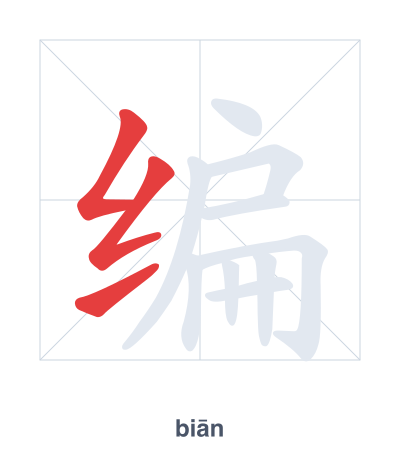
Open Hanzi Writer to see the animated stroke order and practice writing 编 with real-time feedback.
The character 编 (biān) is written with 12 strokes. Follow the standard Chinese stroke order: top to bottom, left to right, outside before inside. The radical 纟 is one of its key components.
Practice the correct stroke order with the Hanzi Writer app to see animated stroke-by-stroke guidance with real-time feedback.
编 means to weave; to edit; to compile.
As an HSK Level 4 character, 编 is an intermediate-level character.
编 combines the silk radical (纟) with the phonetic component 扁 (biǎn), which originally depicted a flat door panel and hints at the flat, interlaced pattern of woven fabric. The character originally meant to weave threads together, later extending to editing and compiling texts, like weaving words into a coherent whole.
💡 Memory Tip: Picture silk threads (纟) being woven into a flat (扁) mat as an editor weaves sentences together.
他在编写一本新书。
tā zài biān xiě yī běn xīn shū
He is writing a new book.
请记住你的座位编号。
qǐng jì zhù nǐ de zuò wèi biān hào
Please remember your seat number.
奶奶在编织一件毛衣。
nǎi nǎi zài biān zhī yī jiàn máo yī
Grandma is knitting a sweater.
Open Hanzi Writer to see the animated stroke order and practice writing 编 with real-time feedback.
✨ Animated stroke order · Handwriting recognition · HSK-graded practice · Free to use
The left side is 纟 (silk radical), which connects to the idea of weaving or binding threads. The right side is 扁 (biǎn, flat), which gives the sound and hints at flattening or organizing threads neatly. Together, they suggest weaving threads into a flat surface, and later extended to editing or compiling text.