纩 (kuàng) means "Silk floss" in Chinese. It has 6 strokes with the radical 纟.
Rated 3.2/5 in difficulty (challenging).
Appears in 3+ common words including 絮纩 (xù kuàng), 纩息 (kuàng xī), 纩被 (kuàng bèi).
Due to its 6 strokes, Hanzi Writer's error detection shows 纩 requires focused practice — most learners need 10+ attempts for consistent accuracy.
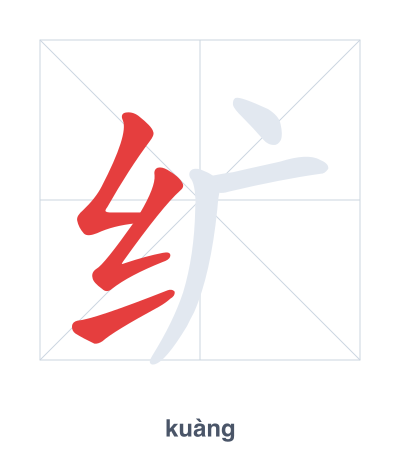
Open Hanzi Writer to see the animated stroke order and practice writing 纩 with real-time feedback.
The character 纩 (kuàng) is written with 6 strokes. Follow the standard Chinese stroke order: top to bottom, left to right, outside before inside. The radical 纟 is one of its key components.
Practice the correct stroke order with the Hanzi Writer app to see animated stroke-by-stroke guidance with real-time feedback.
纩 means Silk floss.
纩 is a phono-semantic compound: the left radical 纟 (silk) indicates the material, while the right component 广 (kuàng, 'wide' or 'broad') provides the pronunciation and hints at the fluffy, expansive quality of silk floss. In ancient times, silk floss was used as padding for winter garments, and the character visually combines silk with the idea of spreading out.
💡 Memory Tip: Imagine a wide (广) sheet of silk (纟) fluffed up like soft cotton candy, filling a large space.
衣服里塞满了絮纩。
yī fú lǐ sāi mǎn le xù kuàng
The clothes are stuffed with silk wadding.
他的纩息很微弱。
tā de kuàng xī hěn wēi ruò
His breathing is very weak.
这是一床旧纩被。
zhè shì yī chuáng jiù kuàng bèi
This is an old silk floss quilt.
Open Hanzi Writer to see the animated stroke order and practice writing 纩 with real-time feedback.
✨ Animated stroke order · Handwriting recognition · HSK-graded practice · Free to use
纩 is composed of the radical 纟 (silk thread) on the left and 广 (kuàng, meaning wide or broad) on the right. The left part indicates that the character relates to silk or textiles, while the right part hints at the fluffy, wide quality of silk floss. Together, they form a character for silk wadding used in quilts or padding.