约 (yāo/yuē) means "Appointment / About" in Chinese. It has 6 strokes with the radical 纟, and is HSK Level 3.
Rated 3.2/5 in difficulty (challenging).
Harder than 32% of HSK Level 3 characters.
Appears in 4+ common words including 约会 (yuē huì), 节约 (jié yuē), 大约 (dà yuē).
Due to its 6 strokes, Hanzi Writer's error detection shows 约 requires focused practice — most learners need 10+ attempts for consistent accuracy.
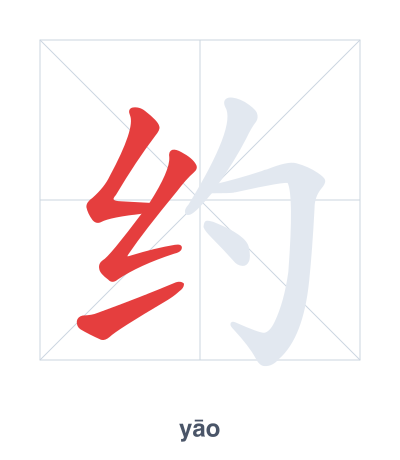
Open Hanzi Writer to see the animated stroke order and practice writing 约 with real-time feedback.
The character 约 (yāo/yuē) is written with 6 strokes. Follow the standard Chinese stroke order: top to bottom, left to right, outside before inside. The radical 纟 is one of its key components.
Practice the correct stroke order with the Hanzi Writer app to see animated stroke-by-stroke guidance with real-time feedback.
约 means Appointment / About.
This is a polyphonic character with readings: yāo, yuē.
As an HSK Level 3 character, 约 is an intermediate-level character.
约 combines 纟 (silk, representing binding) with 勺 (spoon, serving as a phonetic component and suggesting measurement). Originally meaning 'to tie' or 'bind,' it evolved to denote a binding agreement or appointment, as well as an approximate measurement ('about').
💡 Memory Tip: Picture a silk thread (纟) tying a spoon (勺) to a calendar page, marking your important appointment.
我们明天有个约会。
wǒ men míng tiān yǒu gè yuē huì
We have an appointment tomorrow.
请大家节约用水。
qǐng dà jiā jié yuē yòng shuǐ
Everyone, please save water.
他大约五点钟到。
tā dà yuē wǔ diǎn zhōng dào
He will arrive at about five o'clock.
请帮我约一下这个西瓜有几斤。
qǐng bāng wǒ yāo yī xià zhè ge xī guā yǒu jǐ jīn
Please help me estimate how heavy this watermelon is.
Open Hanzi Writer to see the animated stroke order and practice writing 约 with real-time feedback.
✨ Animated stroke order · Handwriting recognition · HSK-graded practice · Free to use
约 has the radical 纟 (silk thread) on the left and 勺 (spoon) on the right. The silk radical hints at binding or tying, which connects to the idea of an appointment (a binding agreement) and also to approximating (tying things together loosely). The spoon part is phonetic and does not carry direct meaning.