纡 (yū) means "winding; circuitous" in Chinese. It has 6 strokes with the radical 纟.
Rated 3.2/5 in difficulty (challenging).
Appears in 3+ common words including 纡回 (yū huí), 纡尊降贵 (yū zūn jiàng guì), 纡曲 (yū qū).
Due to its 6 strokes, Hanzi Writer's error detection shows 纡 requires focused practice — most learners need 10+ attempts for consistent accuracy.
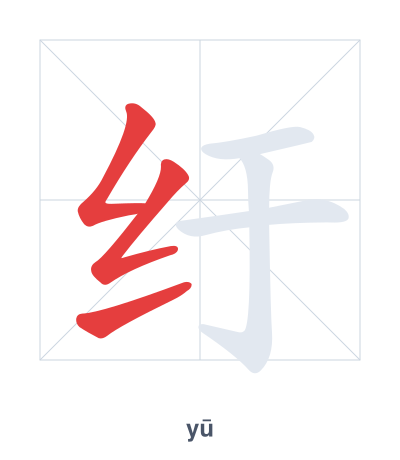
Open Hanzi Writer to see the animated stroke order and practice writing 纡 with real-time feedback.
The character 纡 (yū) is written with 6 strokes. Follow the standard Chinese stroke order: top to bottom, left to right, outside before inside. The radical 纟 is one of its key components.
Practice the correct stroke order with the Hanzi Writer app to see animated stroke-by-stroke guidance with real-time feedback.
纡 means winding; circuitous.
纡 combines the silk radical 纟 (representing threads or fibers) with 于 (yú, originally meaning 'to go' or 'extend'), creating an image of silk threads that twist and curve in a winding, circuitous manner.
💡 Memory Tip: Picture a silk thread (纟) shaped into a big looping 'U' (于) as it twists around a tree, creating a winding path.
山路纡回曲折。
shān lù yū huí qū zhé
The mountain road is winding and circuitous.
他纡尊降贵来帮我。
tā yū zūn jiàng guì lái bāng wǒ
He humbled himself to come and help me.
这里的河流很纡曲。
zhè lǐ de hé liú hěn yū qū
The river here is very winding.
Open Hanzi Writer to see the animated stroke order and practice writing 纡 with real-time feedback.
✨ Animated stroke order · Handwriting recognition · HSK-graded practice · Free to use
纡 is made of two parts: the left radical 纟 (silk thread) and the right component 于 (yu, a phonetic hint). The silk radical suggests something long and flexible, like a thread that can wind or bend. Together, they create the meaning of winding or circuitous paths.