纨 (wán) means "Fine white silk" in Chinese. It has 6 strokes with the radical 纟.
Rated 3.2/5 in difficulty (challenging).
Appears in 3+ common words including 纨绔子弟 (wán kù zǐ dì), 纨扇 (wán shàn), 纨素 (wán sù).
Due to its 6 strokes, Hanzi Writer's error detection shows 纨 requires focused practice — most learners need 10+ attempts for consistent accuracy.
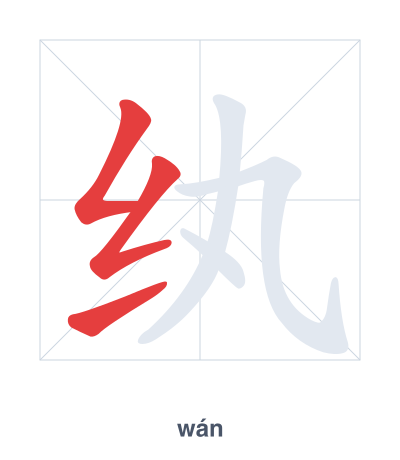
Open Hanzi Writer to see the animated stroke order and practice writing 纨 with real-time feedback.
The character 纨 (wán) is written with 6 strokes. Follow the standard Chinese stroke order: top to bottom, left to right, outside before inside. The radical 纟 is one of its key components.
Practice the correct stroke order with the Hanzi Writer app to see animated stroke-by-stroke guidance with real-time feedback.
纨 means Fine white silk.
纨 is a compound character with the radical 纟 (silk) indicating its connection to textiles, and the phonetic component 丸 (wán, meaning pill or round ball), which hints at the fine, smooth texture associated with high-quality silk. The character specifically refers to a fine white silk fabric, often used in ancient China for luxurious garments.
💡 Memory Tip: Imagine a ball of fine white silk (纟) shaped like a pill (丸) rolling softly on a table.
他是个纨绔子弟。
tā shì gè wán kù zǐ dì
He is a playboy from a wealthy family.
她拿着一把纨扇。
tā ná zhe yī bǎ wán shàn
She is holding a fine silk fan.
这种纨素很轻薄。
zhè zhǒng wán sù hěn qīng bó
This fine white silk is very light and thin.
Open Hanzi Writer to see the animated stroke order and practice writing 纨 with real-time feedback.
✨ Animated stroke order · Handwriting recognition · HSK-graded practice · Free to use
纨 is composed of the radical 纟 (silk) on the left and the phonetic component 丸 (wán, meaning ball or pill) on the right. The silk radical indicates the character relates to silk textiles, while 丸 provides the pronunciation wán. Together, they form the meaning of fine white silk, a luxurious fabric.