纥 (gē/hé) means "Knot / Tassel" in Chinese. It has 6 strokes with the radical 纟.
Rated 3.2/5 in difficulty (challenging).
Appears in 3+ common words including 回纥 (huí hé), 纥纥 (gē gē), 纥络 (gē luò).
Due to its 6 strokes, Hanzi Writer's error detection shows 纥 requires focused practice — most learners need 10+ attempts for consistent accuracy.
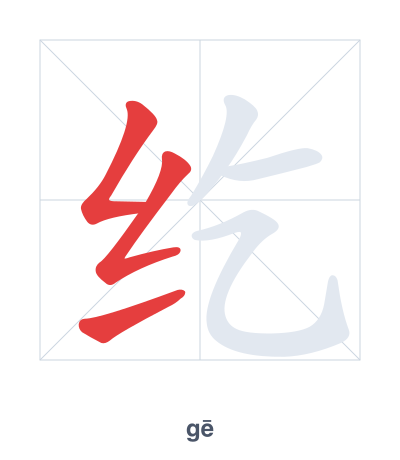
Open Hanzi Writer to see the animated stroke order and practice writing 纥 with real-time feedback.
The character 纥 (gē/hé) is written with 6 strokes. Follow the standard Chinese stroke order: top to bottom, left to right, outside before inside. The radical 纟 is one of its key components.
Practice the correct stroke order with the Hanzi Writer app to see animated stroke-by-stroke guidance with real-time feedback.
纥 means Knot / Tassel.
This is a polyphonic character with readings: gē, hé.
This character is a phono-semantic compound. The left radical 纟 (silk) indicates the meaning relates to silk threads, while the right component 乞 provides an approximate phonetic hint (ancient pronunciation likely closer to gē). Together, they represent a knot or tassel made from twisted silk fibers.
💡 Memory Tip: Picture a silk thread (纟) twisted into a knot that looks like a tiny hand begging (乞) for a tassel to be added.
回纥是古代的民族。
huí hé shì gǔ dài de mín zú
The Uyghur (Huihe) were an ancient ethnic group.
线上有个纥纥。
xiàn shàng yǒu gè gē gē
There is a knot on the thread.
这个纥络很难解开。
zhè ge gē luò hěn nán jiě kāi
This knot is very hard to untie.
Open Hanzi Writer to see the animated stroke order and practice writing 纥 with real-time feedback.
✨ Animated stroke order · Handwriting recognition · HSK-graded practice · Free to use
The left component is 纟, the silk radical, indicating the character relates to thread or fabric. The right part is 乞, which may provide a phonetic clue or suggest a twisting shape. Together they form the idea of a knot or tassel made from silk.