依 (yī) means "to lean on; according to; to depend on" in Chinese. It has 8 strokes with the radical 亻, and is HSK Level 4.
Rated 3.4/5 in difficulty (challenging).
Harder than 26% of HSK Level 4 characters.
Appears in 3+ common words including 依靠 (yī kào), 依然 (yī rán), 依据 (yī jù).
Due to its 8 strokes, Hanzi Writer's error detection shows 依 requires focused practice — most learners need 10+ attempts for consistent accuracy.
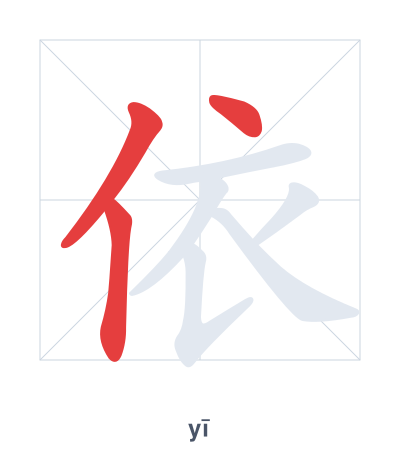
Open Hanzi Writer to see the animated stroke order and practice writing 依 with real-time feedback.
The character 依 (yī) is written with 8 strokes. Follow the standard Chinese stroke order: top to bottom, left to right, outside before inside. The radical 亻 is one of its key components.
Practice the correct stroke order with the Hanzi Writer app to see animated stroke-by-stroke guidance with real-time feedback.
依 means to lean on; according to; to depend on.
As an HSK Level 4 character, 依 is an intermediate-level character.
The character 依 combines the radical 亻 (person) with 衣 (clothing), depicting a person wrapped in or leaning on clothing, symbolizing dependence or support.
💡 Memory Tip: Picture a person (亻) leaning against a large coat (衣) hanging on a hook, relying on it for support.
孩子依靠父母生活。
hái zi yī kào fù mǔ shēng huó
Children depend on their parents for a living.
他依然住在北京。
tā yī rán zhù zài běi jīng
He still lives in Beijing.
说话要有依据。
shuō huà yào yǒu yī jù
Speak with evidence.
Open Hanzi Writer to see the animated stroke order and practice writing 依 with real-time feedback.
✨ Animated stroke order · Handwriting recognition · HSK-graded practice · Free to use
The left side is the radical 亻, which means "person" and indicates that this character relates to people. The right side is 衣, meaning "clothing"; combined, it suggests a person leaning on or depending on something, like leaning on clothing for support.