靠 (kào) means "Lean against; rely on; near" in Chinese. It has 15 strokes with the radical 非, and is HSK Level 2.
Rated 3.3/5 in difficulty (challenging).
Harder than 55% of HSK Level 2 characters.
Appears in 3+ common words including 靠边 (kào biān), 依靠 (yī kào), 靠谱 (kào pǔ).
Due to its 15 strokes, Hanzi Writer's error detection shows 靠 requires focused practice — most learners need 10+ attempts for consistent accuracy.
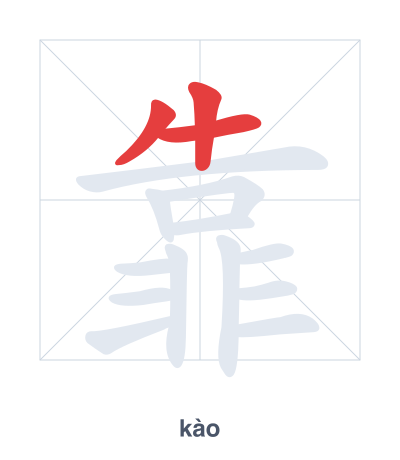
Open Hanzi Writer to see the animated stroke order and practice writing 靠 with real-time feedback.
The character 靠 (kào) is written with 15 strokes. Follow the standard Chinese stroke order: top to bottom, left to right, outside before inside. The radical 非 is one of its key components.
Practice the correct stroke order with the Hanzi Writer app to see animated stroke-by-stroke guidance with real-time feedback.
靠 means Lean against; rely on; near.
As an HSK Level 2 character, 靠 is among the first characters beginners learn.
靠 combines 告 (to announce/report) above 非 (opposition/wrong). The original meaning is 'to lean against' or 'to rely on', possibly derived from the image of leaning sideways against something that is not straight (非). Structurally, it shows a person (implied by 告 as speech) leaning against an opposing force.
💡 Memory Tip: Picture a person leaning against a crooked (非) notice board (告) while reading an announcement, relying on it for support.
请靠边停车。
qǐng kào biān tíng chē
Please pull over.
孩子依靠父母。
hái zi yī kào fù mǔ
Children rely on their parents.
这个人很靠谱。
zhè ge rén hěn kào pǔ
This person is very reliable.
Open Hanzi Writer to see the animated stroke order and practice writing 靠 with real-time feedback.
✨ Animated stroke order · Handwriting recognition · HSK-graded practice · Free to use
靠 is made of two parts: 告 (to tell) on top and 非 (wrong) on the bottom. Together, they suggest telling someone that you are not able to stand alone, which connects to leaning on or relying on someone. This structure helps you remember that 靠 involves depending on something or someone for support.