据 (jū/jù) means "according to; based on" in Chinese. It has 11 strokes with the radical 扌, and is HSK Level 3.
Rated 4.2/5 in difficulty (advanced).
Harder than 76% of HSK Level 3 characters.
Appears in 3+ common words including 根据 (gēn jù), 证据 (zhèng jù), 拮据 (jié jū).
Due to its 11 strokes, Hanzi Writer's error detection shows 据 requires focused practice — most learners need 10+ attempts for consistent accuracy.
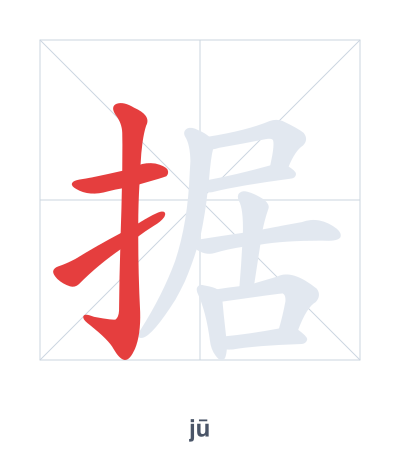
Open Hanzi Writer to see the animated stroke order and practice writing 据 with real-time feedback.
The character 据 (jū/jù) is written with 11 strokes. Follow the standard Chinese stroke order: top to bottom, left to right, outside before inside. The radical 扌 is one of its key components.
Practice the correct stroke order with the Hanzi Writer app to see animated stroke-by-stroke guidance with real-time feedback.
据 means according to; based on.
This is a polyphonic character with readings: jū, jù.
As an HSK Level 3 character, 据 is an intermediate-level character.
据 combines the hand radical 扌 (action of grasping) with 居 (to dwell), originally meaning 'to grasp firmly' or 'to rely on.' Over time, it evolved into 'based on' or 'according to,' as in holding something as a foundation.
💡 Memory Tip: Picture your hand (扌) gripping a house (居) to support your argument — that solid grasp is your basis.
根据天气预报,明天将有一场大范围降雪。
gēn jù tiān qì yù bào míng tiān jiāng yǒu yī cháng dà fàn wéi jiàng xuě
According to the weather forecast, there will be widespread snowfall tomorrow.
在确凿的证据面前,犯罪嫌疑人低下了头。
zài què záo de zhèng jù miàn qián fàn zuì xián yí rén dī xià le tóu
In the face of conclusive evidence, the criminal suspect lowered his head.
刚参加工作那几年,他的生活过得很拮据。
gāng cān jiā gōng zuò nà jǐ nián tā de shēng huó guò dé hěn jié jū
In the first few years of starting work, his life was very tight financially.
Open Hanzi Writer to see the animated stroke order and practice writing 据 with real-time feedback.
✨ Animated stroke order · Handwriting recognition · HSK-graded practice · Free to use
据 is made of the hand radical 扌 on the left and 居 (jū, meaning to dwell) on the right. The hand radical suggests an action, and 居 provides pronunciation and the idea of "occupying" or "holding onto" something. Together, they convey the sense of grasping information as a basis for belief or statement.