仰 (yǎng) means "to look up / to admire" in Chinese. It has 6 strokes with the radical 亻, and is HSK Level 6.
Rated 2.9/5 in difficulty (moderate).
Harder than 6% of HSK Level 6 characters.
Appears in 3+ common words including 仰头 (yǎng tóu), 信仰 (xìn yǎng), 仰望 (yǎng wàng).
Hanzi Writer's stroke validation shows learners typically need 5-8 attempts to write 仰 with correct proportion and order.
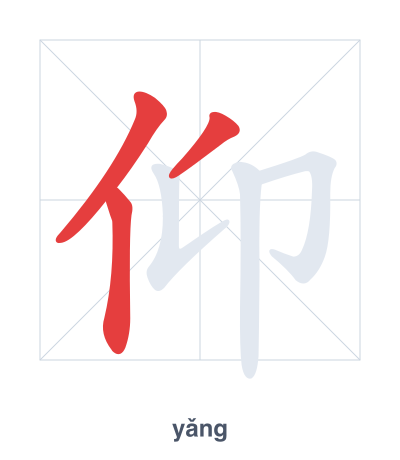
Open Hanzi Writer to see the animated stroke order and practice writing 仰 with real-time feedback.
The character 仰 (yǎng) is written with 6 strokes. Follow the standard Chinese stroke order: top to bottom, left to right, outside before inside. The radical 亻 is one of its key components.
Practice the correct stroke order with the Hanzi Writer app to see animated stroke-by-stroke guidance with real-time feedback.
仰 means to look up / to admire.
As an HSK Level 6 character, 仰 is an intermediate-level character.
仰 combines the person radical 亻 with 卬, an ancient pictograph of a kneeling person with head raised, representing the act of looking upward. Together, they depict a person lifting their gaze, which extends to the abstract sense of admiration or respect.
💡 Memory Tip: Picture a person (亻) craning their neck to see a tall, tilting object (shaped like 卬) above them, filled with awe.
他仰头看天空。
tā yǎng tóu kàn tiān kōng
He looked up at the sky.
每个人都有信仰。
měi gè rén dōu yǒu xìn yǎng
Everyone has a belief.
我仰望星空。
wǒ yǎng wàng xīng kōng
I look up at the starry sky.
Open Hanzi Writer to see the animated stroke order and practice writing 仰 with real-time feedback.
✨ Animated stroke order · Handwriting recognition · HSK-graded practice · Free to use
仰 combines the radical 亻 (person) on the left and the component 卬 on the right. 卬 originally meant "to look upward" or "to raise the head," so together 亻 + 卬 suggests a person looking up. This directly connects to the meanings "to look up" and "to admire."