鸭 (yā) means "Duck" in Chinese. It has 10 strokes with the radical 鸟, and is HSK Level 5.
Rated 4.2/5 in difficulty (advanced).
Harder than 100% of HSK Level 5 characters.
Appears in 3+ common words including 鸭子 (yā zi), 烤鸭 (kǎo yā), 鸭蛋 (yā dàn).
Due to its 10 strokes, Hanzi Writer's error detection shows 鸭 requires focused practice — most learners need 10+ attempts for consistent accuracy.
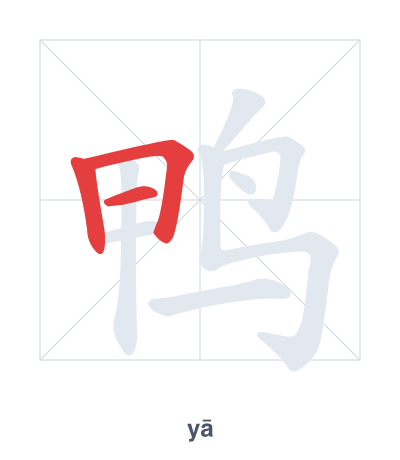
Open Hanzi Writer to see the animated stroke order and practice writing 鸭 with real-time feedback.
The character 鸭 (yā) is written with 10 strokes. Follow the standard Chinese stroke order: top to bottom, left to right, outside before inside. The radical 鸟 is one of its key components.
Practice the correct stroke order with the Hanzi Writer app to see animated stroke-by-stroke guidance with real-time feedback.
鸭 means Duck.
As an HSK Level 5 character, 鸭 is an intermediate-level character.
鸭 is a phono-semantic compound: the radical 鸟 (bird) indicates it is a bird, while the component 甲 (armor) provides the pronunciation 'ya' (though 甲 is usually read as jiǎ, the phonetic connection evolved historically).
💡 Memory Tip: Picture a duck (鸟) wearing armor (甲) on its head, quacking 'ya!' as it marches.
湖里有很多小鸭子。
hú lǐ yǒu hěn duō xiǎo yā zi
There are many ducklings in the lake.
北京烤鸭很好吃。
běi jīng kǎo yā hěn hǎo chī
Beijing roast duck is delicious.
我早餐吃了一个鸭蛋。
wǒ zǎo cān chī le yí gè yā dàn
I had a duck egg for breakfast.
Open Hanzi Writer to see the animated stroke order and practice writing 鸭 with real-time feedback.
✨ Animated stroke order · Handwriting recognition · HSK-graded practice · Free to use
The character 鸭 consists of the left component 甲 (jiǎ, meaning "armor" or "shell") and the right component 鸟 (niǎo, meaning "bird"). The bird radical 鸟 indicates that a duck is a type of bird, while 甲 may refer to the way a duck's body is shaped like a shell or its webbed feet resemble armor.