袅 (niǎo) means "Slender or curling upwards (like smoke)" in Chinese. It has 10 strokes with the radical 鸟.
Rated 4.2/5 in difficulty (advanced).
Appears in 3+ common words including 袅袅 (niǎo niǎo), 袅娜 (niǎo nuó), 袅绕 (niǎo rào).
Due to its 10 strokes, Hanzi Writer's error detection shows 袅 requires focused practice — most learners need 10+ attempts for consistent accuracy.
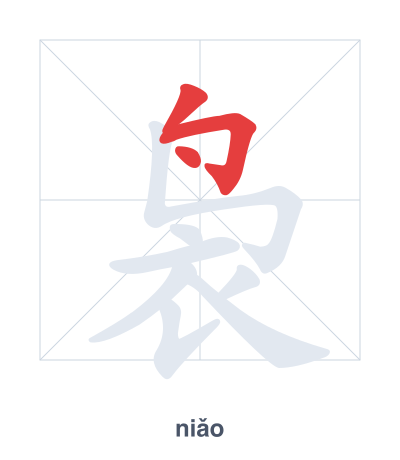
Open Hanzi Writer to see the animated stroke order and practice writing 袅 with real-time feedback.
The character 袅 (niǎo) is written with 10 strokes. Follow the standard Chinese stroke order: top to bottom, left to right, outside before inside. The radical 鸟 is one of its key components.
Practice the correct stroke order with the Hanzi Writer app to see animated stroke-by-stroke guidance with real-time feedback.
袅 means Slender or curling upwards (like smoke).
袅 combines 鸟 (bird) with 衣 (clothing), depicting a bird's long, flowing tail feathers that curl upward—an image that extends to describe slender forms like curling smoke.
💡 Memory Tip: Picture a bird (鸟) in a flowing dress (衣) twirling, its skirt curling up like smoke.
烟雾袅袅升起。
yān wù niǎo niǎo shēng qǐ
Smoke curls upwards.
她的身姿很袅娜。
tā de shēn zī hěn niǎo nuó
Her figure is very lithe and graceful.
歌声在屋里袅绕。
gē shēng zài wū lǐ niǎo rào
The sound of singing lingered in the room.
Open Hanzi Writer to see the animated stroke order and practice writing 袅 with real-time feedback.
✨ Animated stroke order · Handwriting recognition · HSK-graded practice · Free to use
袅 is composed of the radical 鸟 (bird) on top and the component 衣 (clothing) below. The bird radical hints at something light and airy, while 衣 suggests a long, flowing shape. Together they evoke the image of smoke or a slender figure curling upward like a bird in flight or a trailing garment.