鸠 (jiū) means "Dove / Pigeon" in Chinese. It has 7 strokes with the radical 鸟.
Rated 3.5/5 in difficulty (challenging).
Appears in 3+ common words including 斑鸠 (bān jiū), 鸣鸠 (míng jiū), 鸠占鹊巢 (jiū zhàn què cháo).
Due to its 7 strokes, Hanzi Writer's error detection shows 鸠 requires focused practice — most learners need 10+ attempts for consistent accuracy.
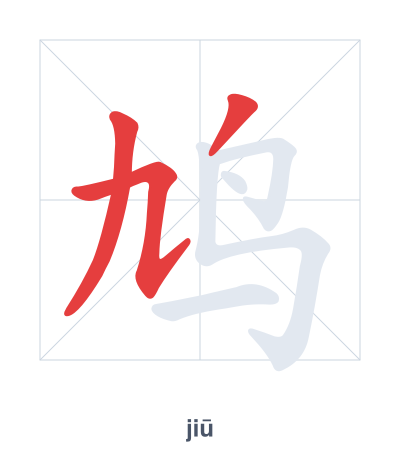
Open Hanzi Writer to see the animated stroke order and practice writing 鸠 with real-time feedback.
The character 鸠 (jiū) is written with 7 strokes. Follow the standard Chinese stroke order: top to bottom, left to right, outside before inside. The radical 鸟 is one of its key components.
Practice the correct stroke order with the Hanzi Writer app to see animated stroke-by-stroke guidance with real-time feedback.
鸠 means Dove / Pigeon.
鸠 is a phono-semantic compound: the radical 鸟 (bird) indicates the meaning 'dove/pigeon,' while 九 (nine) hints at the sound (jiū). Ancient usage referred to a type of pigeon or dove, often associated with gathering or cooing birds.
💡 Memory Tip: Picture nine doves (九) perching together on a bird (鸟) shaped perch, cooing in unison.
我看到一只斑鸠。
wǒ kàn dào yī zhī bān jiū
I saw a turtledove.
鸣鸠在叫。
míng jiū zài jiào
The dove is cooing.
他这是鸠占鹊巢。
tā zhè shì jiū zhàn què cháo
He is usurping someone else's place.
Open Hanzi Writer to see the animated stroke order and practice writing 鸠 with real-time feedback.
✨ Animated stroke order · Handwriting recognition · HSK-graded practice · Free to use
鸠 combines the radical 鸟 (bird) on the right with the phonetic component 九 (jiǔ) on the left. The 鸟 radical indicates this character refers to a type of bird, while 九 gives a hint to the pronunciation jiū.