鸢 (yuān) means "Kite (bird)" in Chinese. It has 8 strokes with the radical 鸟.
Rated 3.7/5 in difficulty (challenging).
Appears in 3+ common words including 纸鸢 (zhǐ yuān), 鸢尾 (yuān wěi), 飞鸢 (fēi yuān).
Due to its 8 strokes, Hanzi Writer's error detection shows 鸢 requires focused practice — most learners need 10+ attempts for consistent accuracy.
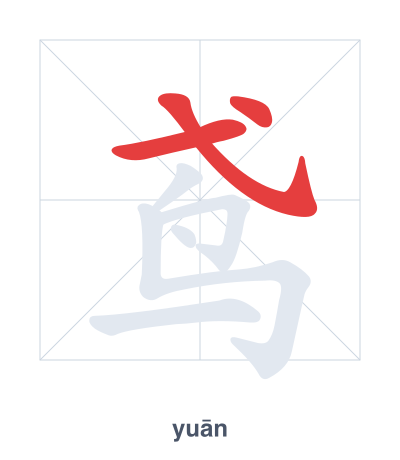
Open Hanzi Writer to see the animated stroke order and practice writing 鸢 with real-time feedback.
The character 鸢 (yuān) is written with 8 strokes. Follow the standard Chinese stroke order: top to bottom, left to right, outside before inside. The radical 鸟 is one of its key components.
Practice the correct stroke order with the Hanzi Writer app to see animated stroke-by-stroke guidance with real-time feedback.
鸢 means Kite (bird).
鸢 is a compound character: the top component 弋 (yì) means 'arrow' or 'dart', and the bottom 鸟 (niǎo) means 'bird'. Together, they depict a bird of prey that darts through the sky like an arrow, referring to the kite (a type of hawk).
💡 Memory Tip: Imagine a kite bird with a sharp, arrow-shaped tail (弋) diving from the sky toward a tiny bird (鸟) below.
孩子们放纸鸢。
hái zi men fàng zhǐ yuān
The children are flying kites.
鸢尾花开了。
yuān wěi huā kāi le
The irises are in bloom.
飞鸢很高。
fēi yuān hěn gāo
The kite is very high.
Open Hanzi Writer to see the animated stroke order and practice writing 鸢 with real-time feedback.
✨ Animated stroke order · Handwriting recognition · HSK-graded practice · Free to use
鸢 is composed of 弋 (arrow or shoot) on top and 鸟 (bird) below. This combination suggests a bird that dives like an arrow, which matches the meaning of 'kite' as a bird of prey.