鸩 (zhèn) means "Poisonous bird (mythical); poison" in Chinese. It has 9 strokes with the radical 鸟.
Rated 4/5 in difficulty (challenging).
Appears in 3+ common words including 鸩毒 (zhèn dú), 饮鸩止渴 (yǐn zhèn zhǐ kě), 鸩酒 (zhèn jiǔ).
Due to its 9 strokes, Hanzi Writer's error detection shows 鸩 requires focused practice — most learners need 10+ attempts for consistent accuracy.
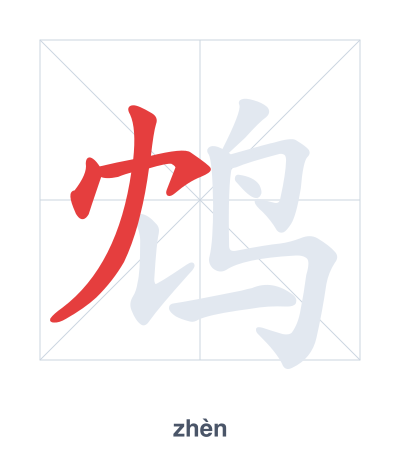
Open Hanzi Writer to see the animated stroke order and practice writing 鸩 with real-time feedback.
The character 鸩 (zhèn) is written with 9 strokes. Follow the standard Chinese stroke order: top to bottom, left to right, outside before inside. The radical 鸟 is one of its key components.
Practice the correct stroke order with the Hanzi Writer app to see animated stroke-by-stroke guidance with real-time feedback.
鸩 means Poisonous bird (mythical); poison.
鸩 is a compound character combining the radical 鸟 (bird) with the phonetic component 冘 (yín), referring to a mythical bird whose poisonous feathers were used to contaminate wine. This character thus visually represents a bird associated with deadly poison.
💡 Memory Tip: Imagine a bird (鸟) carrying a tiny poison dart (冘 shaped like a dart with fletching) that it dips into your drink.
古代人用鸩毒。
gǔ dài rén yòng zhèn dú
Ancient people used poisoned wine.
我们不能饮鸩止渴。
wǒ men bù néng yǐn zhèn zhǐ kě
We cannot seek temporary relief that results in disaster.
鸩酒是有毒的。
zhèn jiǔ shì yǒu dú de
Poisoned wine is toxic.
Open Hanzi Writer to see the animated stroke order and practice writing 鸩 with real-time feedback.
✨ Animated stroke order · Handwriting recognition · HSK-graded practice · Free to use
鸩 is made of two parts: the left side is 歹 (meaning “death” or “bad”) and the right side is 鸟 (meaning “bird”). Together, they suggest a mythical poisonous bird, which is the original meaning of the character.