鸨 (bǎo) means "Bustard" in Chinese. It has 9 strokes with the radical 鸟.
Rated 4/5 in difficulty (challenging).
Appears in 3+ common words including 鸨鸟 (bǎo niǎo), 大鸨 (dà bǎo), 鸨母 (bǎo mǔ).
Due to its 9 strokes, Hanzi Writer's error detection shows 鸨 requires focused practice — most learners need 10+ attempts for consistent accuracy.
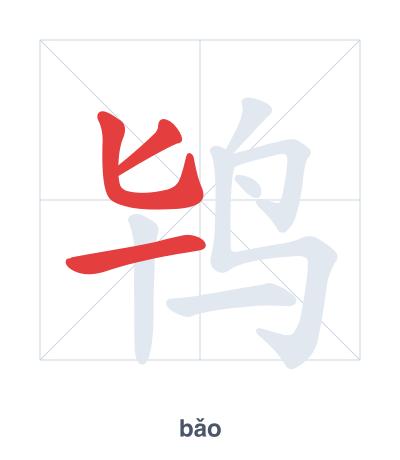
Open Hanzi Writer to see the animated stroke order and practice writing 鸨 with real-time feedback.
The character 鸨 (bǎo) is written with 9 strokes. Follow the standard Chinese stroke order: top to bottom, left to right, outside before inside. The radical 鸟 is one of its key components.
Practice the correct stroke order with the Hanzi Writer app to see animated stroke-by-stroke guidance with real-time feedback.
鸨 means Bustard.
鸨 is a phono-semantic compound: the radical 鸟 indicates 'bird,' while 匕 (bǐ, 'spoon') provides the pronunciation. The bustard is a large, ground-dwelling bird, and the character's structure simply combines the meaning 'bird' with a phonetic hint.
💡 Memory Tip: Picture a bustard bird (鸟) holding a tiny spoon (匕) to scoop up seeds from the ground.
这种鸨鸟非常少见。
zhè zhǒng bǎo niǎo fēi cháng shǎo jiàn
This kind of bustard is very rare.
大鸨在草地上跑。
dà bǎo zài cǎo dì shàng pǎo
The great bustard is running on the grass.
鸨母是古代的词语。
bǎo mǔ shì gǔ dài de cí yǔ
"Baomu" is an ancient term.
Open Hanzi Writer to see the animated stroke order and practice writing 鸨 with real-time feedback.
✨ Animated stroke order · Handwriting recognition · HSK-graded practice · Free to use
The left side is 鸟 (bird radical), which shows this character is about a bird. The right side is 㐤 (bǎo, meaning 'to protect' or 'to bundle'), but here it mainly provides the pronunciation bǎo. Together, they form the name of the bustard bird.