鸧 (cāng) means "Oriole" in Chinese. It has 9 strokes with the radical 鸟.
Rated 4/5 in difficulty (challenging).
Appears in 3+ common words including 鸧鹒 (cāng gēng), 鸧鸟 (cāng niǎo), 鸧鹩 (cāng liáo).
Due to its 9 strokes, Hanzi Writer's error detection shows 鸧 requires focused practice — most learners need 10+ attempts for consistent accuracy.
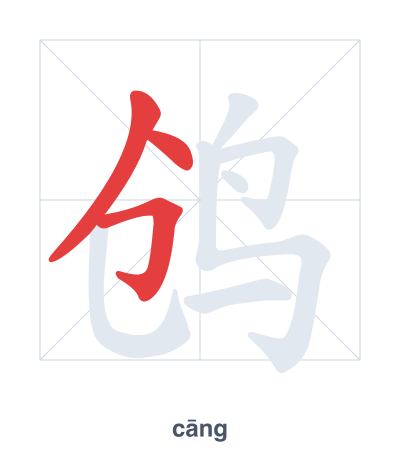
Open Hanzi Writer to see the animated stroke order and practice writing 鸧 with real-time feedback.
The character 鸧 (cāng) is written with 9 strokes. Follow the standard Chinese stroke order: top to bottom, left to right, outside before inside. The radical 鸟 is one of its key components.
Practice the correct stroke order with the Hanzi Writer app to see animated stroke-by-stroke guidance with real-time feedback.
鸧 means Oriole.
鸧 is a phono-semantic compound: the radical 鸟 (bird) indicates its meaning as an oriole, while the component 仓 (cāng, granary) provides the pronunciation. The character blends a bird's form with a sound hint, linking the oriole to the idea of a storehouse (perhaps for its song or nesting).
💡 Memory Tip: Picture a bright yellow oriole perched on the roof of a grain granary (仓), chirping its lively tune—bird (鸟) plus storehouse equals the oriole's home.
鸧鹒在唱歌。
cāng gēng zài chàng gē
The oriole is singing.
鸧鸟很漂亮。
cāng niǎo hěn piào liàng
The oriole is very beautiful.
鸧鹩在飞。
cāng liáo zài fēi
The wren is flying.
Open Hanzi Writer to see the animated stroke order and practice writing 鸧 with real-time feedback.
✨ Animated stroke order · Handwriting recognition · HSK-graded practice · Free to use
鸧 is made of two parts: the left side 仓 (cāng, meaning "granary") and the right side 鸟 (niǎo, meaning "bird"). The left part gives a hint about the pronunciation, while the right part shows that it is a type of bird. Together, they form the character for "oriole."