鸦 (yā) means "Crow" in Chinese. It has 9 strokes with the radical 鸟, and is HSK Level 7.
Rated 4/5 in difficulty (challenging).
Harder than 47% of HSK Level 7 characters.
Appears in 3+ common words including 乌鸦 (wū yā), 鸦片 (yā piàn), 鸦雀无声 (yā què wú shēng).
Due to its 9 strokes, Hanzi Writer's error detection shows 鸦 requires focused practice — most learners need 10+ attempts for consistent accuracy.
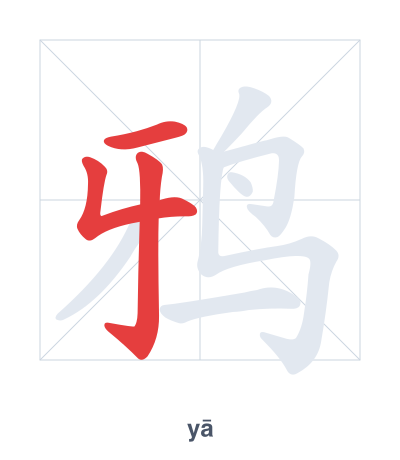
Open Hanzi Writer to see the animated stroke order and practice writing 鸦 with real-time feedback.
The character 鸦 (yā) is written with 9 strokes. Follow the standard Chinese stroke order: top to bottom, left to right, outside before inside. The radical 鸟 is one of its key components.
Practice the correct stroke order with the Hanzi Writer app to see animated stroke-by-stroke guidance with real-time feedback.
鸦 means Crow.
As an HSK Level 7 character, 鸦 is an intermediate-level character.
鸦 (yā) is a compound character combining the phonetic component 牙 (yá, 'tooth') with the semantic component 鸟 (bird). The character signifies a type of bird whose harsh call resembles the sound 'ya', and the tooth component hints at the crow's sharp, biting voice.
💡 Memory Tip: Imagine a crow with a sharp tooth (牙) sticking out of its beak, cawing 'ya-ya' at you.
乌鸦是黑色的。
wū yā shì hēi sè de
Crows are black.
鸦片有害健康。
yā piàn yǒu hài jiàn kāng
Opium is harmful to health.
教室里鸦雀无声。
jiào shì lǐ yā què wú shēng
The classroom was dead silent.
Open Hanzi Writer to see the animated stroke order and practice writing 鸦 with real-time feedback.
✨ Animated stroke order · Handwriting recognition · HSK-graded practice · Free to use
鸦 is made of two parts: the left side 牙 (yá, meaning 'tooth' or 'fang') and the right side 鸟 (niǎo, meaning 'bird'). The 鸟 radical indicates it is a type of bird, and 牙 gives the sound "yā" while also suggesting the crow's sharp beak like a tooth.