胸 (xiōng) means "chest; breast" in Chinese. It has 10 strokes with the radical 月, and is HSK Level 4.
Rated 4.2/5 in difficulty (advanced).
Harder than 88% of HSK Level 4 characters.
Appears in 3+ common words including 胸口 (xiōng kǒu), 胸部 (xiōng bù), 胸怀 (xiōng huái).
Due to its 10 strokes, Hanzi Writer's error detection shows 胸 requires focused practice — most learners need 10+ attempts for consistent accuracy.
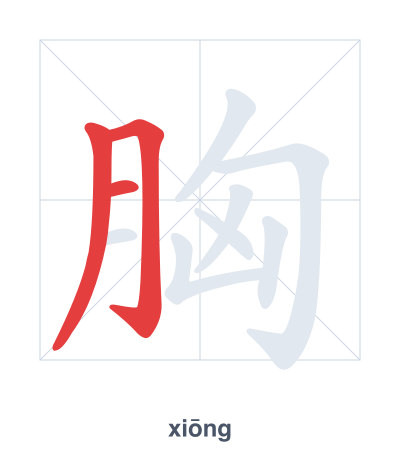
Open Hanzi Writer to see the animated stroke order and practice writing 胸 with real-time feedback.
The character 胸 (xiōng) is written with 10 strokes. Follow the standard Chinese stroke order: top to bottom, left to right, outside before inside. The radical 月 is one of its key components.
Practice the correct stroke order with the Hanzi Writer app to see animated stroke-by-stroke guidance with real-time feedback.
胸 means chest; breast.
As an HSK Level 4 character, 胸 is an intermediate-level character.
The character 胸 combines the flesh radical 月 (indicating a body part) with 匈 (xiōng), an ancient pictograph of a person's chest cavity that also provides the pronunciation. Together, 月 specifies the bodily location, while 匈 clarifies it as the chest or breast area.
💡 Memory Tip: Picture a crescent moon (月) sitting on top of a ribcage (匈) to remember that 胸 means chest.
他觉得胸口有点疼。
tā jué de xiōng kǒu yǒu diǎn téng
He feels a bit of pain in his chest.
游泳可以锻炼胸部。
yóu yǒng kě yǐ duàn liàn xiōng bù
Swimming can exercise the chest muscles.
老师的胸怀很宽广。
lǎo shī de xiōng huái hěn kuān guǎng
The teacher is very broad-minded.
Open Hanzi Writer to see the animated stroke order and practice writing 胸 with real-time feedback.
✨ Animated stroke order · Handwriting recognition · HSK-graded practice · Free to use
The character 胸 is made of the radical 月 (meat/flesh) on the left and the phonetic component 匈 on the right. The 月 radical indicates the character relates to body parts, and 匈 originally suggested the chest area. Together, they form the meaning of "chest" or "breast."