怀 (huái) means "to cherish; bosom; to be pregnant" in Chinese. It has 7 strokes with the radical 忄, and is HSK Level 4.
Rated 3.5/5 in difficulty (challenging).
Harder than 32% of HSK Level 4 characters.
Appears in 3+ common words including 怀疑 (huái yí), 怀念 (huái niàn), 怀抱 (huái bào).
Due to its 7 strokes, Hanzi Writer's error detection shows 怀 requires focused practice — most learners need 10+ attempts for consistent accuracy.
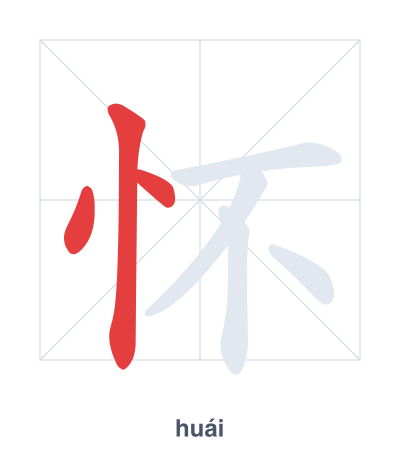
Open Hanzi Writer to see the animated stroke order and practice writing 怀 with real-time feedback.
The character 怀 (huái) is written with 7 strokes. Follow the standard Chinese stroke order: top to bottom, left to right, outside before inside. The radical 忄 is one of its key components.
Practice the correct stroke order with the Hanzi Writer app to see animated stroke-by-stroke guidance with real-time feedback.
怀 means to cherish; bosom; to be pregnant.
As an HSK Level 4 character, 怀 is an intermediate-level character.
The left radical 忄 (heart) conveys emotion or inner feeling. The right component 不 (meaning 'not') suggests a heart that does not want to release something cherished, like a memory or a baby in the womb. Together, 怀 visually represents holding close to the heart.
💡 Memory Tip: Picture a heart (忄) stubbornly saying 'no' (不) to letting go of a cherished person held in your bosom.
我怀疑他在说谎。
wǒ huái yí tā zài shuō huǎng
I suspect he is lying.
我很怀念家乡。
wǒ hěn huái niàn jiā xiāng
I really miss my hometown.
妈妈怀抱孩子。
mā mā huái bào hái zi
Mother holds the child in her arms.
Open Hanzi Writer to see the animated stroke order and practice writing 怀 with real-time feedback.
✨ Animated stroke order · Handwriting recognition · HSK-graded practice · Free to use
怀 combines the radical 忄 (heart/mind) on the left and 不 (no) on the right, but 不 here acts as a phonetic component, not a semantic one. The heart radical suggests emotions or feelings, which connects to meanings like 'to cherish' or 'to be pregnant' (carrying feelings or a baby).