朊 (ruǎn) means "prion" in Chinese. It has 8 strokes with the radical 月.
Rated 3.7/5 in difficulty (challenging).
Appears in 3+ common words including 朊病毒 (ruǎn bìng dú), 朊蛋白 (ruǎn dàn bái), 朊 (ruǎn).
Due to its 8 strokes, Hanzi Writer's error detection shows 朊 requires focused practice — most learners need 10+ attempts for consistent accuracy.
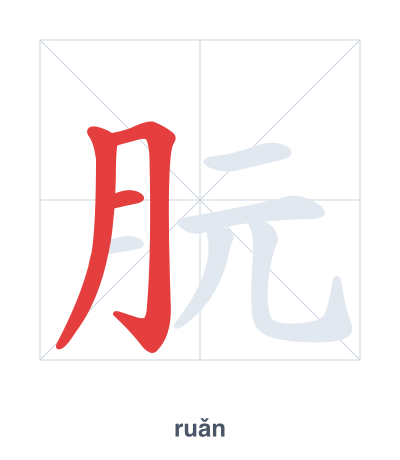
Open Hanzi Writer to see the animated stroke order and practice writing 朊 with real-time feedback.
The character 朊 (ruǎn) is written with 8 strokes. Follow the standard Chinese stroke order: top to bottom, left to right, outside before inside. The radical 月 is one of its key components.
Practice the correct stroke order with the Hanzi Writer app to see animated stroke-by-stroke guidance with real-time feedback.
朊 means prion.
朊 is a compound character: the radical 月 (flesh/meat) indicates it relates to the body or protein, and 元 (yuán, meaning 'first' or 'original') hints at prions as misfolded proteins that can be considered 'original' infectious agents. Thus, the character visually combines 'flesh' with 'original' to denote a fundamental protein particle.
💡 Memory Tip: Imagine a prion as a 'moon' (月) made of 'dollar bills' (元)—an original, infectious piece of protein that's worth a fortune to scientists.
什么是朊病毒?
shén me shì ruǎn bìng dú
What is a prion?
朊蛋白很重要。
ruǎn dàn bái hěn zhòng yào
Prion proteins are very important.
朊是蛋白质。
ruǎn shì dàn bái zhì
Prions are proteins.
Open Hanzi Writer to see the animated stroke order and practice writing 朊 with real-time feedback.
✨ Animated stroke order · Handwriting recognition · HSK-graded practice · Free to use
朊 is composed of the radical 月 (meat or flesh) on the left, and 元 (yuán, meaning 'original' or 'first') on the right. The 月 radical connects to the idea of protein (a bodily substance), while 元 suggests the 'original' infectious agent — together they indicate a protein that is the cause of disease.