部 (bù) means "part / section / department" in Chinese. It has 10 strokes with the radical 阝, and is HSK Level 2.
Rated 3.4/5 in difficulty (challenging).
Harder than 59% of HSK Level 2 characters.
Appears in 3+ common words including 全部 (quán bù), 部分 (bù fèn), 部门 (bù mén).
Due to its 10 strokes, Hanzi Writer's error detection shows 部 requires focused practice — most learners need 10+ attempts for consistent accuracy.
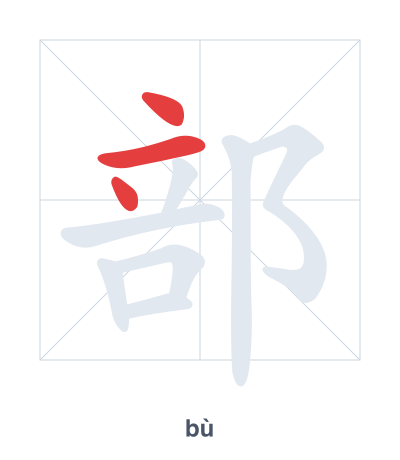
Open Hanzi Writer to see the animated stroke order and practice writing 部 with real-time feedback.
The character 部 (bù) is written with 10 strokes. Follow the standard Chinese stroke order: top to bottom, left to right, outside before inside. The radical 阝 is one of its key components.
Practice the correct stroke order with the Hanzi Writer app to see animated stroke-by-stroke guidance with real-time feedback.
部 means part / section / department.
As an HSK Level 2 character, 部 is among the first characters beginners learn.
部 combines the radical 阝 (a town or settlement) with the phonetic component 咅 (a standing person with a mouth), originally referring to a district or administrative division within a town, which later generalized to mean any part, section, or department.
💡 Memory Tip: Imagine a town (阝) where a person standing (立) shouts with a big mouth (口) to announce the different departments (部) of the town.
这些书全部是我的。
zhè xiē shū quán bù shì wǒ de
All of these books are mine.
只有一部分人来了。
zhǐ yǒu yī bù fèn rén lái le
Only some of the people came.
他在那个部门工作。
tā zài nà ge bù mén gōng zuò
He works in that department.
Open Hanzi Writer to see the animated stroke order and practice writing 部 with real-time feedback.
✨ Animated stroke order · Handwriting recognition · HSK-graded practice · Free to use
部 is made of two parts: the left side 咅 (a phonetic component) and the right side 阝, which is the radical meaning 'city' or 'place'. This structure originally referred to a division or administrative area, giving the modern meanings of 'part', 'section', or 'department'.