朐 (qú) means "Qu (a place name); dried meat" in Chinese. It has 9 strokes with the radical 月.
Rated 4/5 in difficulty (challenging).
Appears in 3+ common words including 临朐 (lín qú), 朐 (qú), 朐肉 (qú ròu).
Due to its 9 strokes, Hanzi Writer's error detection shows 朐 requires focused practice — most learners need 10+ attempts for consistent accuracy.
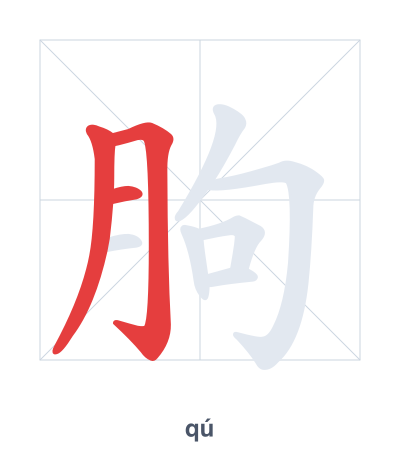
Open Hanzi Writer to see the animated stroke order and practice writing 朐 with real-time feedback.
The character 朐 (qú) is written with 9 strokes. Follow the standard Chinese stroke order: top to bottom, left to right, outside before inside. The radical 月 is one of its key components.
Practice the correct stroke order with the Hanzi Writer app to see animated stroke-by-stroke guidance with real-time feedback.
朐 means Qu (a place name); dried meat.
朐 is a compound character with the radical 月 (meat/flesh) indicating its original meaning relates to meat, and the component 句 (qú) providing pronunciation. It originally referred to dried meat, possibly meat that is curved or bent like a hook, which is a meaning derived from the shape of 句 (meaning curved).
💡 Memory Tip: Imagine a chunk of dried meat (月) bent into a hook shape (句) hanging in the marketplace of the ancient place Qu.
临朐在山东。
lín qú zài shān dōng
Linqu is in Shandong.
朐是地名。
qú shì dì míng
Qu is a place name.
朐肉是干肉。
qú ròu shì gàn ròu
Qu-rou is dried meat.
Open Hanzi Writer to see the animated stroke order and practice writing 朐 with real-time feedback.
✨ Animated stroke order · Handwriting recognition · HSK-graded practice · Free to use
朐 is composed of the radical 月 (meat/flesh) on the left and 句 (jù, sentence/section) on the right. The 月 radical suggests a connection to meat or flesh, which links to the meaning "dried meat." The component 句 may provide the pronunciation cue (qú, though 句 is usually jù), while the place name meaning "Qu" is a historical usage without clear semantic connection to the parts.