朕 (zhèn) means "I (imperial 'we', used by emperors)" in Chinese. It has 10 strokes with the radical 月.
Rated 4.2/5 in difficulty (advanced).
Appears in 2+ common words including 朕 (zhèn), 朕兆 (zhèn zhào).
Due to its 10 strokes, Hanzi Writer's error detection shows 朕 requires focused practice — most learners need 10+ attempts for consistent accuracy.
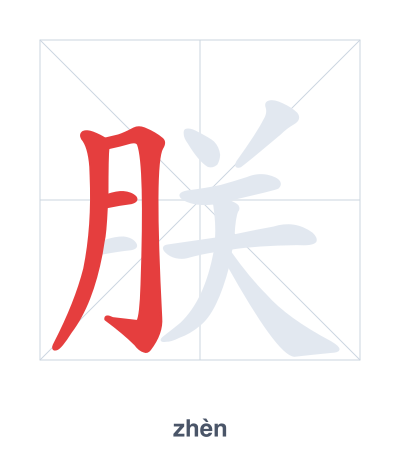
Open Hanzi Writer to see the animated stroke order and practice writing 朕 with real-time feedback.
The character 朕 (zhèn) is written with 10 strokes. Follow the standard Chinese stroke order: top to bottom, left to right, outside before inside. The radical 月 is one of its key components.
Practice the correct stroke order with the Hanzi Writer app to see animated stroke-by-stroke guidance with real-time feedback.
朕 means I (imperial 'we', used by emperors).
Originally, 朕 depicted a boat (舟, later mistaken as 月) with a hand sealing a crack (the right component was 灷, two hands holding fire to mend), meaning 'to repair a seam.' This sense was borrowed for the imperial first-person pronoun, as the emperor's authoritative 'I' seals all statements. Today, the left radical 月 (flesh/moon) and right 关 (close) suggest the emperor's 'I' shuts out all others.
💡 Memory Tip: Picture the emperor alone under a full moon (月), closing a gate (关) behind him and declaring, 'I am the only one.'
朕知道了。
zhèn zhī dào le
I have been informed (Imperial response).
朕是皇帝。
zhèn shì huáng dì
I am the emperor.
这是一个朕兆。
zhè shì yí gè zhèn zhào
This is an omen.
Open Hanzi Writer to see the animated stroke order and practice writing 朕 with real-time feedback.
✨ Animated stroke order · Handwriting recognition · HSK-graded practice · Free to use
朕 is composed of the radical 月 (moon/body) on the left and 关 (a phonetic component) on the right. The 月 radical here actually represents 'flesh' or 'body', hinting at a connection to the emperor's person. The right side provides pronunciation, while the whole character historically meant 'I' as used exclusively by emperors.