朔 (shuò) means "New moon; north" in Chinese. It has 10 strokes with the radical 月.
Rated 4.2/5 in difficulty (advanced).
Appears in 3+ common words including 朔日 (shuò rì), 朔风 (shuò fēng), 朔方 (shuò fāng).
Due to its 10 strokes, Hanzi Writer's error detection shows 朔 requires focused practice — most learners need 10+ attempts for consistent accuracy.
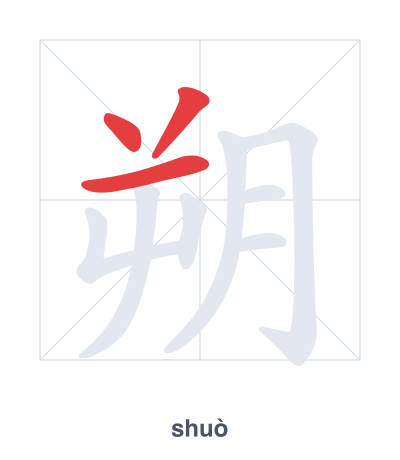
Open Hanzi Writer to see the animated stroke order and practice writing 朔 with real-time feedback.
The character 朔 (shuò) is written with 10 strokes. Follow the standard Chinese stroke order: top to bottom, left to right, outside before inside. The radical 月 is one of its key components.
Practice the correct stroke order with the Hanzi Writer app to see animated stroke-by-stroke guidance with real-time feedback.
朔 means New moon; north.
朔 combines 屰 (reverse, contrary) with 月 (moon), literally meaning the moon's opposite phase—when the moon is invisible (new moon). By extension, it also came to mean 'north,' as the moon's light is absent from that direction in traditional Chinese cosmology.
💡 Memory Tip: Imagine a reversed crescent moon (屰) over the regular moon (月) to remember that 朔 is the new moon, when the moon's face is completely dark.
今天是朔日。
jīn tiān shì shuò rì
Today is the first day of the lunar month.
朔风很冷。
shuò fēng hěn lěng
The north wind is very cold.
他去了朔方。
tā qù le shuò fāng
He went to the northern regions.
Open Hanzi Writer to see the animated stroke order and practice writing 朔 with real-time feedback.
✨ Animated stroke order · Handwriting recognition · HSK-graded practice · Free to use
朔 is composed of two parts: the left side 屰 (meaning 'inverse' or 'opposite') and the right side 月 (moon). Together, they suggest the moon being opposite the sun, which is when the new moon occurs (the moon is invisible). The meaning 'north' comes from the idea of the north wind or direction associated with the new moon phase.