赏 (shǎng) means "to reward; to grant; to appreciate" in Chinese. It has 12 strokes with the radical 贝, and is HSK Level 4.
Rated 4.2/5 in difficulty (advanced).
Harder than 92% of HSK Level 4 characters.
Appears in 3+ common words including 赏脸 (shǎng liǎn), 欣赏 (xīn shǎng), 奖赏 (jiǎng shǎng).
Due to its 12 strokes, Hanzi Writer's error detection shows 赏 requires focused practice — most learners need 10+ attempts for consistent accuracy.
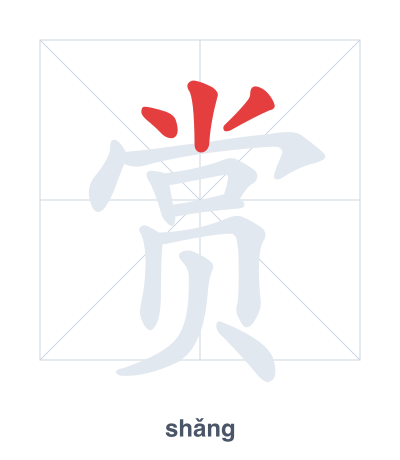
Open Hanzi Writer to see the animated stroke order and practice writing 赏 with real-time feedback.
The character 赏 (shǎng) is written with 12 strokes. Follow the standard Chinese stroke order: top to bottom, left to right, outside before inside. The radical 贝 is one of its key components.
Practice the correct stroke order with the Hanzi Writer app to see animated stroke-by-stroke guidance with real-time feedback.
赏 means to reward; to grant; to appreciate.
As an HSK Level 4 character, 赏 is an intermediate-level character.
赏 combines 尚 (shàng, meaning 'to esteem' or 'still') above 贝 (bèi, 'shell' as money), suggesting the idea of giving valuables as a reward or showing appreciation. The top part 尚 also contributes the sound, while 贝 indicates the material aspect of granting treasures or cash. This structure originally depicted the act of bestowing gifts or monetary rewards as a form of honor or recognition.
💡 Memory Tip: Imagine someone holding up a shiny shell (贝) on a high pedestal (尚) to reward and appreciate a great achievement.
请您赏脸吃个饭。
qǐng nín shǎng liǎn chī gè fàn
Please do me the honor of having a meal with me.
我很欣赏你的才华。
wǒ hěn xīn shǎng nǐ de cái huá
I really appreciate your talent.
老师奖赏了学生。
lǎo shī jiǎng shǎng le xué shēng
The teacher rewarded the students.
Open Hanzi Writer to see the animated stroke order and practice writing 赏 with real-time feedback.
✨ Animated stroke order · Handwriting recognition · HSK-graded practice · Free to use
赏 is composed of 尚 (shàng) on top and 贝 (bèi, shell/money) at the bottom. The 尚 provides a phonetic hint for pronunciation and suggests the idea of 'above', while 贝 represents wealth, together conveying the concept of a superior granting money or rewards.