喜 (xǐ) means "happy / joy / to like" in Chinese. It has 12 strokes with the radical 口, and is HSK Level 1.
Rated 3.7/5 in difficulty (challenging).
Harder than 84% of HSK Level 1 characters.
Appears in 3+ common words including 喜欢 (xǐ huān), 喜悦 (xǐ yuè), 喜剧 (xǐ jù).
Due to its 12 strokes, Hanzi Writer's error detection shows 喜 requires focused practice — most learners need 10+ attempts for consistent accuracy.
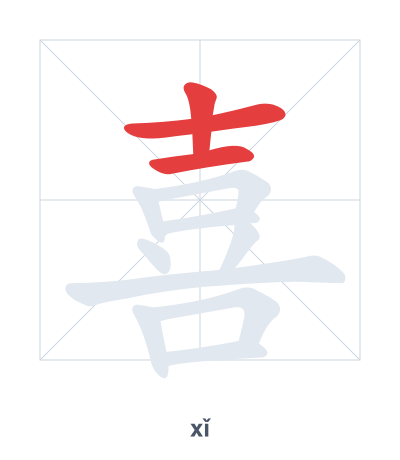
Open Hanzi Writer to see the animated stroke order and practice writing 喜 with real-time feedback.
The character 喜 (xǐ) is written with 12 strokes. Follow the standard Chinese stroke order: top to bottom, left to right, outside before inside. The radical 口 is one of its key components.
Practice the correct stroke order with the Hanzi Writer app to see animated stroke-by-stroke guidance with real-time feedback.
喜 means happy / joy / to like.
As an HSK Level 1 character, 喜 is among the first characters beginners learn.
喜 combines a drum (壴, showing a drum on a stand) above a mouth (口), representing the joy of music and singing together. The ancient form depicted a drum with an open mouth below, symbolizing celebration and happiness from rhythmic sound.
💡 Memory Tip: Picture a drum with two stacked lids (壴) above a big smiling mouth (口) — drumming makes you grin with joy!
我喜欢学中文。
wǒ xǐ huān xué zhōng wén
I like learning Chinese.
脸上充满了喜悦。
liǎn shàng chōng mǎn le xǐ yuè
The face is full of joy.
我爱看喜剧片。
wǒ ài kàn xǐ jù piàn
I love watching comedies.
Open Hanzi Writer to see the animated stroke order and practice writing 喜 with real-time feedback.
✨ Animated stroke order · Handwriting recognition · HSK-graded practice · Free to use
喜 is made of three parts: 士 (scholar) on top, 口 (mouth) in the middle, and 豆 (bean) at the bottom. The mouth (口) symbolizes smiling or singing, and together the parts evoke the idea of celebration and happiness.